The gap between them is not a story about slow adoption. It is a story about what breaks when you try to run stablecoin payroll at scale, across multiple jurisdictions, for a real workforce, with real compliance obligations. According to StablecoinInsider's 2026 analysis, the transaction itself works. What does not yet work reliably is everything built around it.
The Fiat Wrapper Problem
The most important thing to understand about stablecoin payroll in 2026 is that regulation in every major market has converged on the same structural answer. Salaries must be denominated in local fiat. Stablecoins can be the rail that moves the money. They cannot replace the fiat denomination. As Transak's stablecoin playbook for 2026 frames it, the model that works is fiat in, stablecoin settlement, fiat out — with the stablecoin layer invisible to the worker where regulation requires it.
In the US, post-GENIUS Act, payment stablecoins have a clear regulatory framework and licensed issuers. But federal and state labour law still requires wages to be denominated in dollars and payable in a form employees can actually use. In the EU, MiCA has clarified stablecoin issuance, but directly denominating wages in crypto remains legally sensitive. In Nigeria, wages must be paid in naira through permitted channels — crypto cannot replace the salary obligation, and any stablecoin component has to be structured as a separate benefit valued in local currency. In Brazil, Bill PL 957/2025 would allow part of wages in crypto, but as of early 2026 it remains under discussion, with any approved framework requiring at least 50 percent of base salary to remain in reais.
The operational consequence is this: most compliant stablecoin payroll implementations are not replacing fiat payroll. They are adding a stablecoin layer alongside it. The HR system records salary in fiat, by contract. The payment execution layer converts or routes through stablecoins. And somewhere in the middle, a team has to reconcile the two.
Where It Actually Breaks
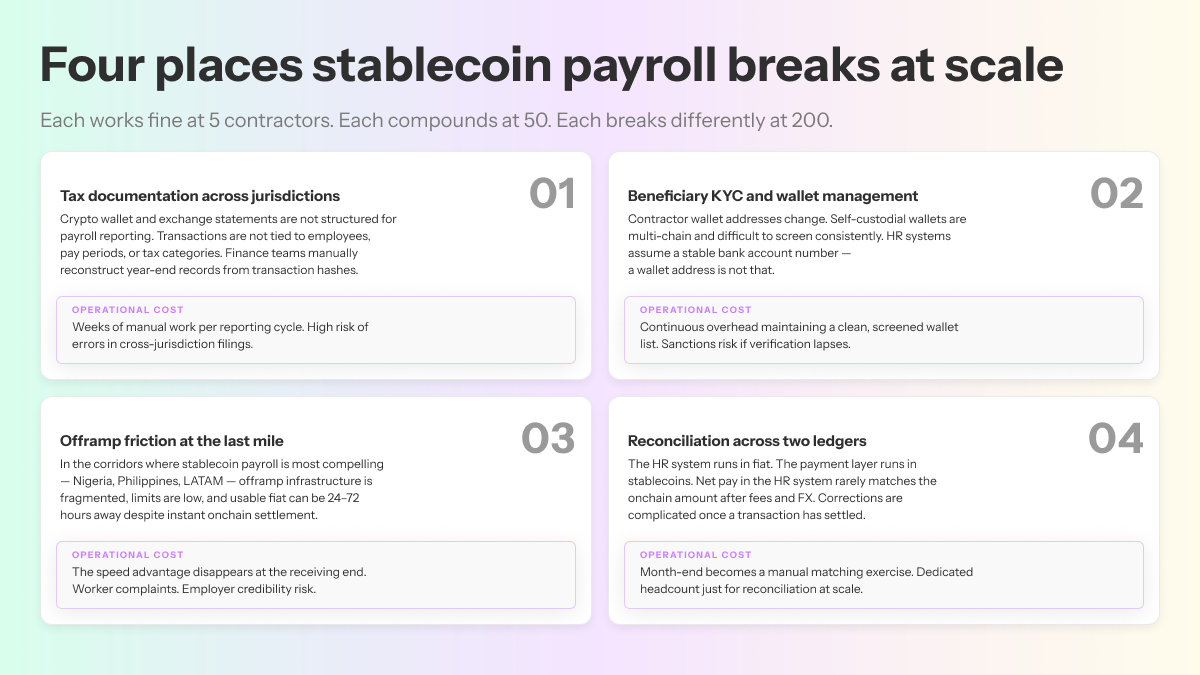
The most commonly cited pain points from operators running stablecoin payroll at scale fall into four categories, documented across Transak's 2026 infrastructure guide for payroll providers and Rise's adoption research.
Tax documentation across jurisdictions. Even when payment is made in stablecoins, withholding and reporting obligations apply in local legal tender. Most crypto wallet and exchange statements are not structured for payroll reporting: transactions are not tied to employees, pay periods, or tax categories. Finance teams are manually reconstructing these records from transaction hashes, applying conversion rates at the time of payment, and producing year-end statements that standard accounting software was not built to generate from onchain data.
Beneficiary management and KYC. Contractor wallet addresses change. Self-custodial wallets are multi-chain and difficult to screen consistently. EOR platforms must KYC workers and their wallets, which breaks assumptions built into traditional HR systems that expect a bank account number to stay stable. Maintaining a clean, current, sanctions-screened list of wallet addresses across a distributed contractor network is a meaningful operational burden at scale.
Offramp friction at the last mile. Most recipients still need local fiat. In the corridors where stablecoin payroll is most compelling, including Nigeria, the Philippines, and parts of Latin America, offramp infrastructure is fragmented, limits are low, and the time between onchain settlement and usable cash in the recipient's hands can run to 24 to 72 hours. The speed advantage of stablecoin rails is real at the sending end. It often disappears at the receiving end.
Reconciliation across two ledgers. At month-end, most teams running stablecoin payroll are manually matching two separate records: the HR system in fiat, and the onchain or exchange records in stablecoins. The net pay in the HR system rarely aligns precisely with the onchain amount delivered after fees and FX conversion. Corrections and reversals, straightforward in traditional payroll, are complicated once a blockchain transaction has settled. Rise's 2026 report identifies this dual-ledger reconciliation problem as one of the most time-consuming parts of running crypto payroll at any meaningful scale.
What the Market Is Building Around It
The major EOR and payroll platforms have all moved in this direction over the last 18 months. Papaya Global launched Banco Wallet in January 2026, a global workforce wallet built on Fireblocks infrastructure supporting fiat and stablecoin payouts across 180 countries. Deel announced stablecoin salary payouts to non-custodial wallets via MoonPay in February 2026, rolling out to UK and EU markets in March. Remote has offered stablecoin payout options through partner rails since late 2024. As Transak's EOR analysis notes, all three platforms shipped within the same short window, not as experiments, but as production features responding to measurable demand.
What these launches share is a common architecture: fiat denomination at the employment contract layer, stablecoin rails at the payment execution layer, and the expectation that workers choose what they receive. The employer funds in fiat or stablecoins. The platform handles conversion and routing. The worker receives in their preferred currency or asset.
This architecture solves the transaction problem. It does not yet solve the reconciliation problem, the tax documentation problem, or the beneficiary management problem at scale. According to StablecoinInsider's vendor analysis, the platforms building these products are investing heavily in the payment rails. The operational tooling that sits around those rails — the reporting, compliance documentation, ledger reconciliation — is still being built.
The Scale Question
For a company making a handful of contractor payments in stablecoins each month, the current tooling is adequate. The transaction works. Reconciliation is manageable manually. Tax documentation is a quarterly exercise. The picture changes at 50 contractors across 10 jurisdictions. It changes again at 200. The operational overhead does not scale linearly with headcount. It scales faster, because each jurisdiction adds compliance complexity and each stablecoin standard adds a reconciliation layer. Crypto payroll practitioners describe this clearly: the tooling that handles 10 contractors breaks at 100, and the fixes required to handle 100 are not the same fixes that will handle 1,000.
The companies running stablecoin payroll at genuine scale today are not doing it cleanly. They have built internal operations functions around the gaps: dedicated finance team members whose job is partly payroll reconciliation, relationships with specific offramp providers per corridor, and custom compliance workflows that sit between the HR system and the payment layer. That is not a failure of the technology. It is a sign that the infrastructure layer around the technology has not kept pace with the use case.
Stablecoin payroll works. The question for any business considering it at scale is not whether the transactions will settle. It is whether the operational infrastructure exists to run it reliably, compliantly, and without rebuilding your finance function from scratch to accommodate it.