
Ask a finance lead at a crypto-native business what month-end looks like and you get a consistent answer: it starts with exporting CSVs. One from the bank. One from the exchange. Several from wallets. Then comes the normalisation: converting blockchain transaction data into something an accounting system can interpret, matching records across systems that were never designed to talk to each other, and reconciling balances that are simultaneously correct onchain and impossible to verify from a traditional general ledger. The underlying money is real. The accounting infrastructure around it was built for a different era.
This is not a niche problem. As B2B stablecoin payment volumes grow and more businesses hold meaningful balances onchain, the gap between how money moves and how it gets recorded is becoming one of the most consequential operational constraints in crypto-native finance. Fireblocks’ acquisition of Tres Finance for $130 million in January 2026 — Tres being a crypto accounting and subledger platform — signals clearly that the infrastructure industry has noticed. The problem is real enough that custody providers are now buying their way into the accounting layer.
Why Stablecoins Are Not Just Digital Cash
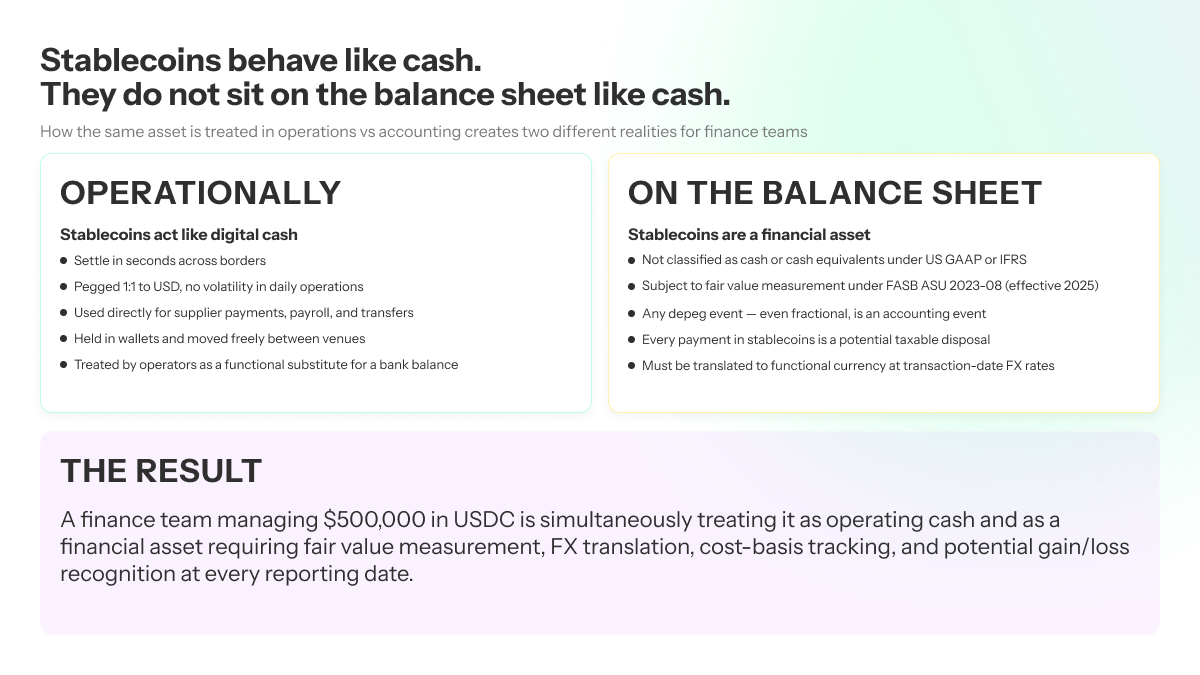
The most common misconception about stablecoin accounting is that because USDC is pegged to the dollar, it behaves like cash. It does not, at least not in accounting terms. The two dominant global accounting frameworks, US Generally Accepted Accounting Principles (US GAAP) and the International Financial Reporting Standards (IFRS) used in the UK, EU, and most of the rest of the world, both generally treat stablecoins as financial assets rather than cash. They fail the standard test: they are not legal tender, and there is non-negligible risk of change in value given the possibility of a depeg, even for the most regulated issuers. That classification has downstream consequences for every entry in the books.
Under US GAAP, the Financial Accounting Standards Board (FASB) issued a new rule — ASU 2023-08 — that took effect for most companies in 2025. It requires businesses to measure qualifying crypto assets at fair value at every reporting date, with any change in that value flowing directly through the income statement. In plain terms: if you hold $500,000 in USDC and there is a brief depeg event, even a fraction of a percent, that becomes an accounting event requiring documentation and disclosure. As Weaver’s summary of the rule explains, businesses can no longer simply carry crypto at cost and ignore market fluctuations between reporting periods.
Under IFRS, the situation is different but not simpler. The International Accounting Standards Board (IASB), which sets IFRS, has declined to issue a crypto-specific standard. That leaves businesses to apply existing rules — either IAS 38, the intangible assets standard, or IAS 2, the inventory standard — depending on how and why they hold crypto. The result, as the ICAEW notes in its analysis of the divergence, is that the same stablecoin balance can be treated very differently depending on which accounting framework a business uses, creating real complexity for any company with investors, entities, or auditors in multiple jurisdictions.
Where the Books Actually Break
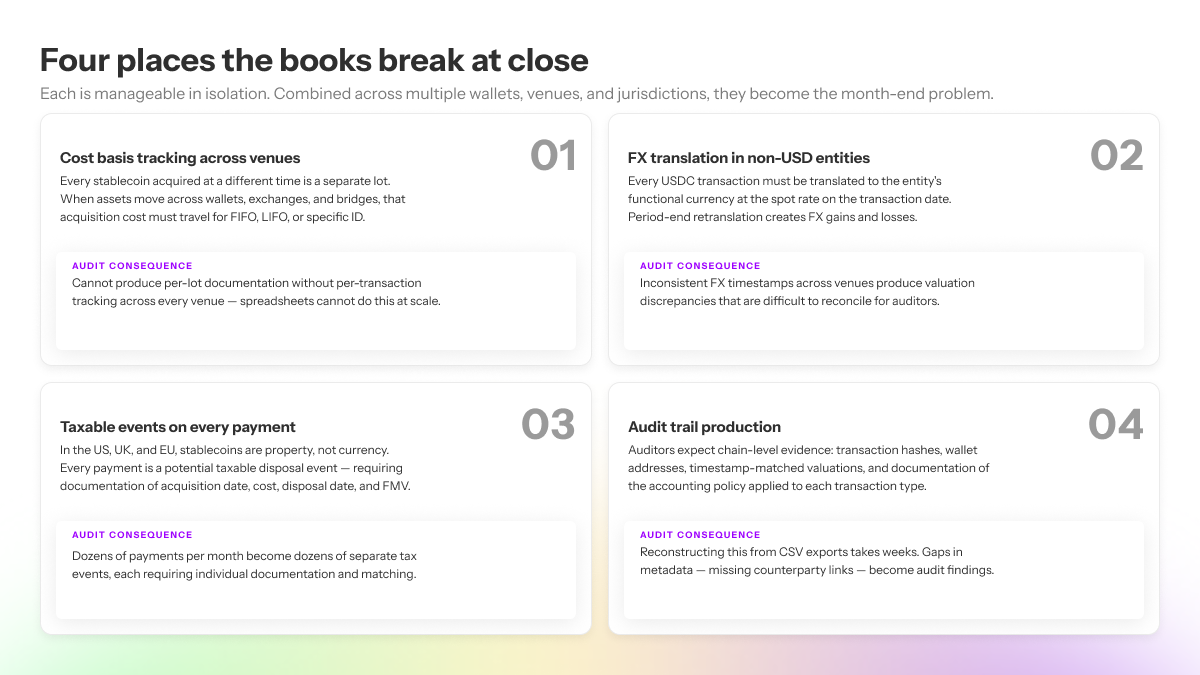
The accounting standard question is the policy layer. The operational layer is where month-end actually gets painful. There are four specific points where crypto-native accounting consistently breaks down.
Cost basis tracking across venues. Every stablecoin acquired at a different time, even at a fractionally different price, is a separate lot for accounting purposes. Different cost tracking methods (first-in-first-out, last-in-first-out, or tracking each specific lot individually) all require knowing the original acquisition cost of each unit as it moves across wallets, exchanges, and bridges. When an asset moves from a wallet to an exchange to another wallet before being used for a payment, the acquisition cost of that specific lot has to travel with it through every step. Bitwave’s guide for accountants describes this as one of the most technically complex aspects of crypto accounting: the blockchain records every movement, but translating those movements into auditable cost records requires infrastructure that most standard accounting systems do not have natively.
FX translation for businesses outside the US. For businesses whose primary operating currency is not the US dollar, holding USDC adds a layer of foreign exchange complexity that does not exist for purely dollar-denominated businesses. Every USDC transaction must be translated into the business’s functional currency at the exchange rate on the transaction date. Every balance must then be retranslated at the rate on the last day of the reporting period. The difference between those two rates creates foreign exchange gains and losses that have to be recorded in the accounts. For a business in Nigeria, the UK, or Indonesia, movements in the naira, sterling, or rupiah against the dollar are not a rounding problem. They are material.
Taxable events on every payment. In the US, UK, and EU, crypto, including stablecoins, is treated as property rather than currency for tax purposes. That means every time a business uses stablecoins to pay a supplier or contractor, it is potentially a taxable disposal event. If the stablecoin was acquired at a different value than when it was spent, a capital gain or loss may arise. The income received is recognised at the fair market value of the tokens at the point of receipt. For a business making dozens of stablecoin payments per month, each one is a separate tax event requiring documentation of when the asset was acquired, what it cost, when it was disposed of, and what it was worth at that point.
Audit trail production. Auditors increasingly expect chain-level evidence: the unique transaction identifier for each blockchain movement, wallet addresses involved, valuations matched to timestamps, and documentation of the accounting policy applied to each type of transaction. Cryptio’s analysis of reconciliation gaps identifies this as the hidden cost of fragmented crypto data: teams can reconstruct what happened, but producing the documentation an auditor needs — per transaction, per lot, with consistent methodology — is a manual exercise that takes weeks rather than hours when it is done from raw blockchain exports and spreadsheets.
What Teams Are Actually Doing
Most crypto-native finance teams are patching this with a combination of dedicated tools and significant manual effort. The tools have improved substantially. Tres Finance’s research documents a case where a team spending roughly 40 hours per week on manual reconciliation for 50,000 daily transactions reduced that to under 5 hours after implementing a dedicated accounting subledger — a separate system that tracks crypto transactions in the detail required before feeding summarised entries into the main accounting system — with reconciliation accuracy improving to 99.8%. That is a meaningful improvement. It is also available only to teams large enough and technically capable enough to implement and maintain a dedicated platform.
For most operators, the reality is closer to what Cryptoworth describes: CSV exports from each venue, normalisation in spreadsheets, manual assignment of cost basis, exchange rates, and general ledger account codes, and line-by-line checking against blockchain explorers. The process is accurate enough until something goes wrong — a missed transaction, an inconsistent timestamp, a bridge interaction that does not map cleanly to any standard transaction type — and then it becomes an audit issue rather than just an operational inconvenience.
The dedicated tools that exist — Cryptio, Tres (now part of Fireblocks), Bitwave, Cryptoworth — are well-built for the problems they solve: ingesting blockchain data, normalising it, and producing a subledger that can feed into standard accounting systems. Where they fall short is in the integration layer: they handle major exchanges and chains well but may not capture every interaction with decentralised finance protocols, cross-chain bridges, or custom smart contracts out of the box. And they stop at the subledger, the final mapping of categories into accounting and enterprise resource planning systems, and the maintenance of accounting policies across multiple jurisdictions, still requires human judgment and manual configuration. The infrastructure is improving. The gap between a technically correct close and a fully auditable one is still largely filled by humans.
The Standard Is Now Raising the Bar
The 2025 implementation of the new FASB fair value rule across US calendar-year entities has tightened expectations precisely as stablecoin volumes are growing. Businesses that previously carried crypto at cost now have to mark it to market at every reporting date and disclose material holdings and changes. WS Advisors’ summary of the requirements notes that this includes enhanced disclosure about significant holdings, restrictions on assets, and activity during the period — requirements that are straightforward for a business with a single wallet and one exchange relationship, and genuinely complex for one operating across multiple entities, chains, and currencies.
The Fireblocks acquisition of Tres Finance in January 2026 is the clearest market signal of where this is heading. When a custody and infrastructure provider pays $130 million for an accounting subledger, it is because their enterprise clients are telling them that the accounting and reporting layer is no longer an optional add-on. It is a requirement for operating at scale. Deloitte’s 2026 stablecoin paper frames the shift clearly: stablecoin accounting and internal controls have moved from a finance team problem to a board-level concern. The regulatory environment is tightening, audit expectations are rising, and businesses that cannot produce clean, auditable records of their onchain activity are going to find it increasingly difficult to raise capital, pass due diligence, or operate in regulated markets.
For most crypto-native businesses today, closing the books is a manual exercise that takes longer than it should, produces results accurate enough for internal management but not fully auditable, and depends on institutional knowledge about what lives where and how it was classified last quarter. That is a workable arrangement at small scale. It is not a workable arrangement for a business that is growing.