The funding gap for businesses in emerging markets is well-documented. Companies operating in Southeast Asia, Sub-Saharan Africa, and Latin America face structural constraints on access to capital that their counterparts in developed markets do not. These constraints are real, and the consequences for growth are significant.
But capital alone does not determine what a business can do. Once money arrives, a second constraint kicks in: the infrastructure required to deploy it. Settlement delays, FX friction, account fragility, and compliance gaps can neutralise the operational benefit of funding even when access to capital has been solved. The two problems are related but distinct, and conflating them has led many conversations about emerging market finance to stop one step too early.
The Capital Gap Is Real. It Is Also Half the Story.
Emerging market businesses face a financing gap estimated in the trillions. The IFC has long tracked the credit shortfall for small and medium enterprises in developing economies, and recent data continues to reflect it. The numbers are stark: US and European markets absorb more than 80 percent of global venture capital flows, while emerging markets receive less than five percent, despite accounting for a growing share of the world’s highest-growth economies. In Sub-Saharan Africa, SME financing needs remain substantially unmet through formal channels. In Southeast Asia, digital lending platforms have expanded access but have not closed the gap for businesses that need working capital tied to operational cycles rather than consumer-style credit products.That underfunding exists despite compelling evidence of return. Cambridge Associates data shows emerging market venture funds posting 40 to 50 percent higher IRRs than their developed market peers. Africa leads with an 11 percent net IRR, driven by digitisation and valuation arbitrage, compared to 7.4 percent for US and developed market funds. The structural case for capital deployment in these regions is not speculative. It is already in the performance data.
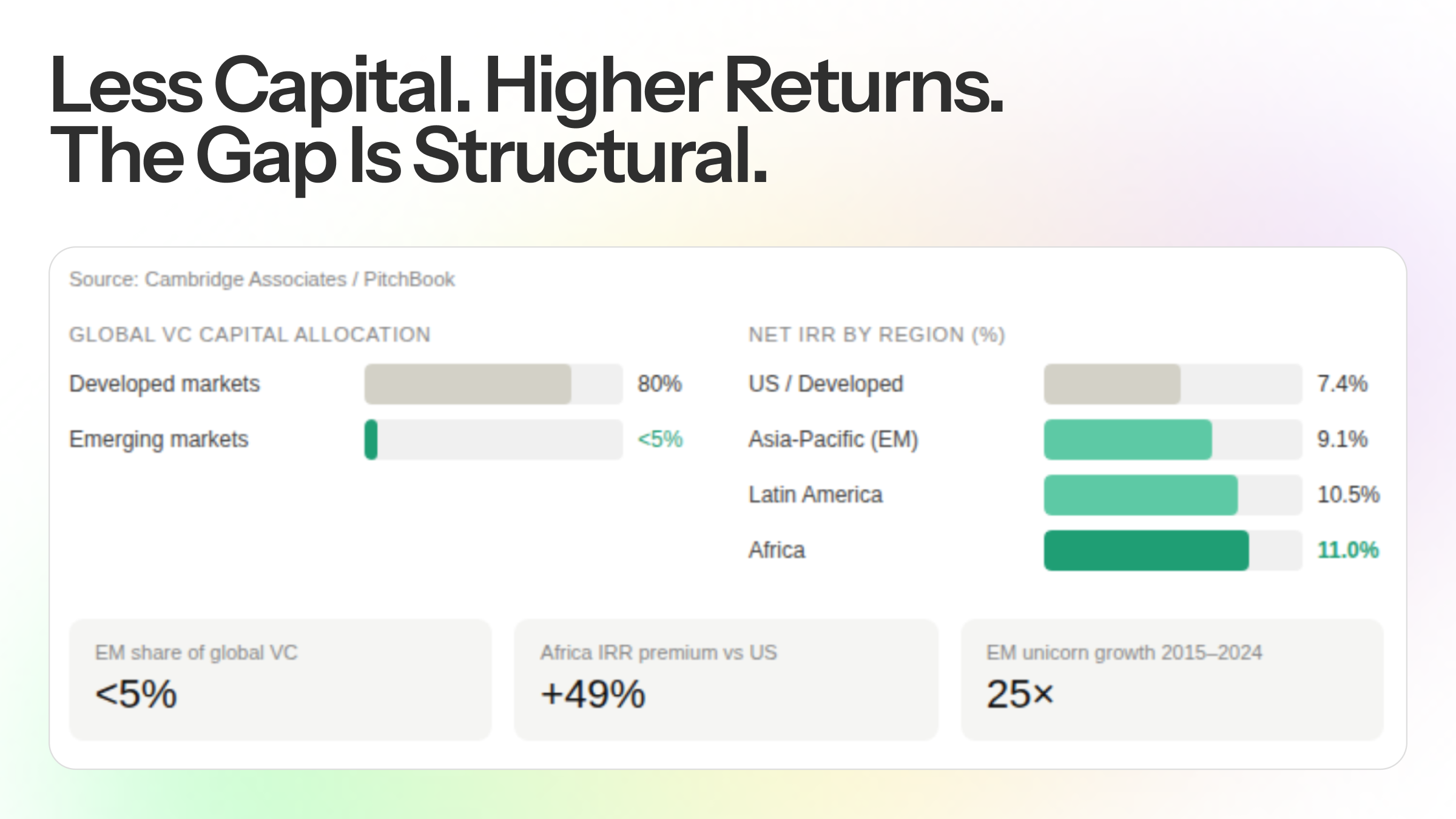
The growth of crypto-native capital channels has added a new dimension to this picture. Decentralised protocols, token-based incentives, and global stablecoin flows have extended access to liquidity in ways that traditional lending has not. Founders in Lagos, Jakarta, and Bogota can now receive funding from counterparties in Geneva or Singapore with settlement speed and cost structures that would have been unavailable five years ago. Emerging markets grew from three venture-backed unicorns in 2015 to 76 by 2024, a 25-fold increase driven largely by these regions’ ability to attract and deploy capital more efficiently than their developed market peers once access was available.
That shift is genuine. But it has also created a new category of problem. Capital, once received, has to be used. And the infrastructure through which it is deployed, the accounts, rails, payment workflows, and reporting systems, was not designed for the way these businesses actually operate.
What Happens After the Money Arrives
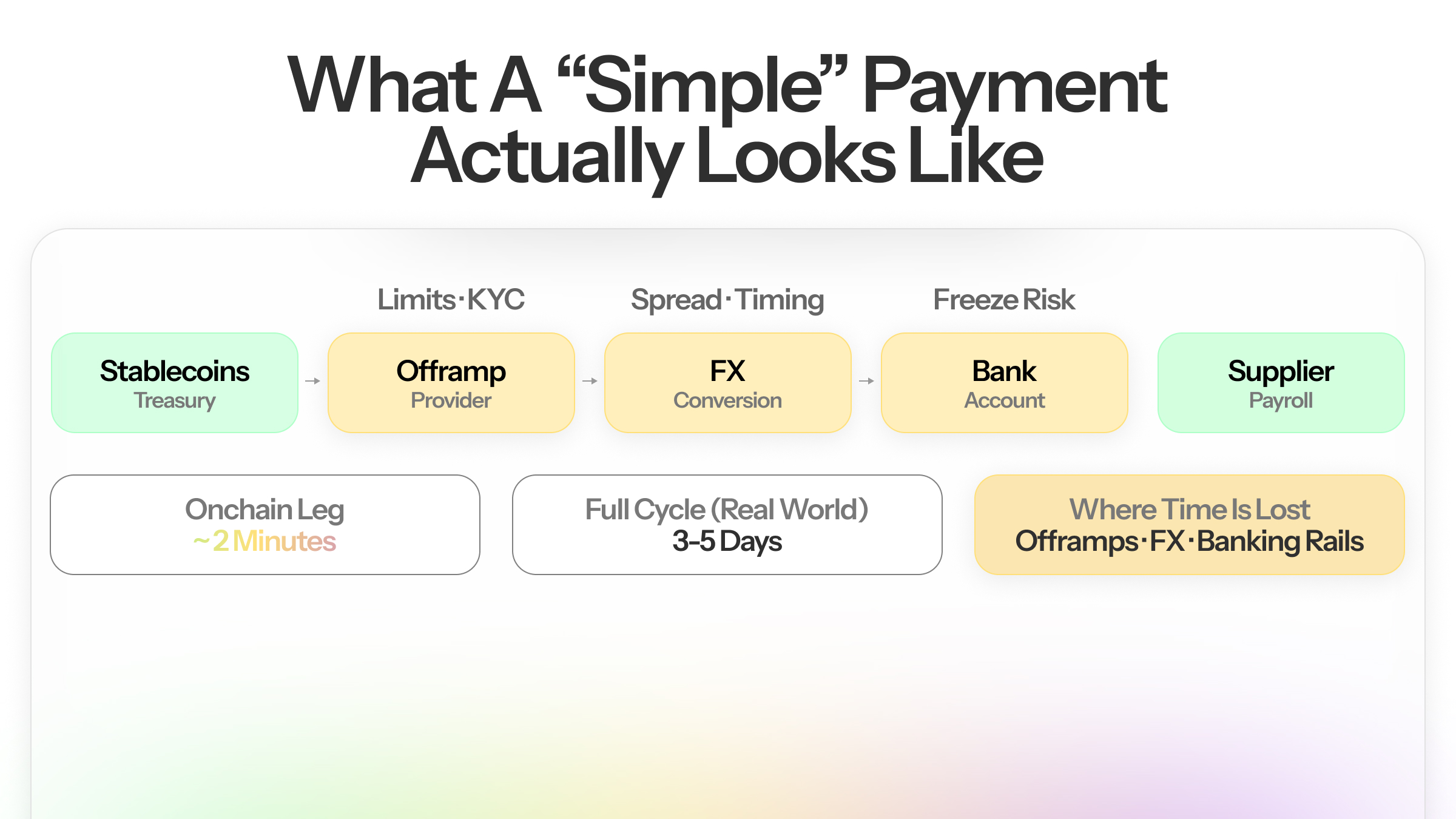
The moment a business tries to use its capital, the rails become the constraint. Consider a straightforward operational cycle: a founder receives stablecoin funding, needs to pay a supplier in a different jurisdiction, cover local payroll in fiat, and maintain enough liquidity to manage a 30-day receivables gap. Each of these steps encounters a different failure point.
Supplier payments across borders typically require an offramp that can handle the relevant currency pair. Where those offramps exist, settlement times vary, limits apply, and compliance documentation is required at each step. Where they do not exist, the business needs a workaround: a regional exchange, a peer-to-peer transfer, or an informal arrangement, each of which introduces cost, delay, and counterparty risk.
Local payroll requires fiat. Converting stablecoins to local currency, moving funds through a bank account, and issuing payments to employees or contractors on the right schedule depends on infrastructure that does not operate in real time across all jurisdictions. A payment leg that fails, is flagged for review, or exceeds a daily transfer limit creates operational exposure even when the underlying funds are fully available.
Working capital management requires visibility. Knowing how much is available across which accounts, in which currencies, with what settlement horizon, is not a reporting convenience. It determines whether a business can confidently commit to a purchase order, extend payment terms to a customer, or manage a short-term liquidity gap without defaulting on an obligation. Most businesses in this position are managing this across multiple wallets, exchanges, and bank accounts simultaneously, with limited consolidated visibility and no automated reconciliation.
Settlement Delays Are Not a Minor Inconvenience
In high-friction markets, settlement timing is a working capital variable, not a back-office footnote. A payment that takes three to five days to clear in a market with thin liquidity and volatile local currency is not just slow. It is a period of financial exposure during which the value of what was sent and the value of what is received can diverge materially.
Businesses that have adopted stablecoins as their primary treasury asset have partially addressed this problem. Dollar-pegged settlement removes FX volatility for the portion of the business that operates in stablecoins. But the last mile, converting to local currency, paying a vendor who does not accept stablecoins, or satisfying a tax obligation denominated in the local unit, still routes through traditional rails with traditional settlement timelines.
The companies that manage this well are not the ones with access to better capital. They are the ones that have built operational infrastructure around the constraints. They have mapped which rails work reliably in which corridors, identified which offramp providers offer predictable settlement, and built internal processes to manage the gaps. That operational knowledge, accumulated through iteration and often through failure, is not scalable in its current form. It depends on specific people, specific vendor relationships, and institutional memory that does not transfer easily.
FX Friction Compounds Across the Operating Cycle
Foreign exchange costs are rarely presented as an operational constraint in discussions of emerging market finance. They show up in the treasury section or in pricing models. But for businesses that operate across multiple currency zones, FX friction is embedded in every step of the operating cycle.
A business that receives revenue in USD equivalent, pays suppliers in local currency, and reports to investors in a third denomination is managing multiple FX positions simultaneously. Each conversion carries a spread. Each conversion decision involves a timing judgment. And each mismatch between revenue recognition and payment execution is a source of untracked exposure.
The scale of FX costs in cross-border business operations is often underestimated. World Bank data has consistently shown that remittance corridors targeting Sub-Saharan Africa and parts of Southeast Asia carry among the highest transfer costs globally, with averages that can reach 7 to 9 percent in certain markets. Business payments face similar structural costs, compounded by lower transaction volumes relative to the per-transaction overhead of managing compliance and documentation.
Stablecoins have reduced this cost at the onchain layer. But the offchain settlement leg still introduces spread, and the total cost of a complete payment cycle, from stablecoin treasury to fiat in the hands of a supplier or employee, often exceeds what the onchain component suggests.
Account Fragility Is an Operational Risk, Not a Banking Complaint
Account access is treated as a baseline assumption in most financial infrastructure discussions. For businesses in certain emerging markets, it is not. Account freezes, withdrawal limits, and documentation requirements imposed without notice are not edge cases. They are recurring operational events that businesses plan around.
A business that depends on a single bank account for fiat settlement is exposed to whatever policies that institution applies, whenever they apply them. The risk is not abstract. Founders across Africa and Southeast Asia have described scenarios in which accounts were frozen pending review, transfers were blocked due to compliance flags raised by the receiving institution rather than the sender, and withdrawal limits were reduced without prior notice during periods of local financial stress.
The standard response is diversification: maintain accounts at multiple institutions, route payments through different providers depending on the corridor, and hold enough liquidity in crypto to bridge gaps when a fiat rail is temporarily unavailable. This works. But it requires operational overhead that is not the same thing as a solution. It is a workaround to the absence of reliable infrastructure.
Why This Matters for Adoption, Not Just Operations
Stablecoin adoption in emerging markets has accelerated significantly. Chainalysis data has consistently ranked Sub-Saharan Africa, Southeast Asia, and Latin America among the highest-growth regions for crypto adoption, with grassroots usage driven by practical needs rather than speculation. The scale of the underlying market explains why: Africa alone processed over $1.1 trillion in mobile money flows in 2024, with two thirds originating from the continent, and four in ten Africans are projected to use mobile wallets with Web3 rails by 2030. In Latin America, 51 percent of consumers have already made a crypto payment or transfer. In Southeast Asia, unicorn creation grew 32-fold between 2015 and 2024, with companies in the region increasingly using crypto rails for treasury and cross-border operations. Across all three regions, 65 percent of global Web3 growth is now concentrated.
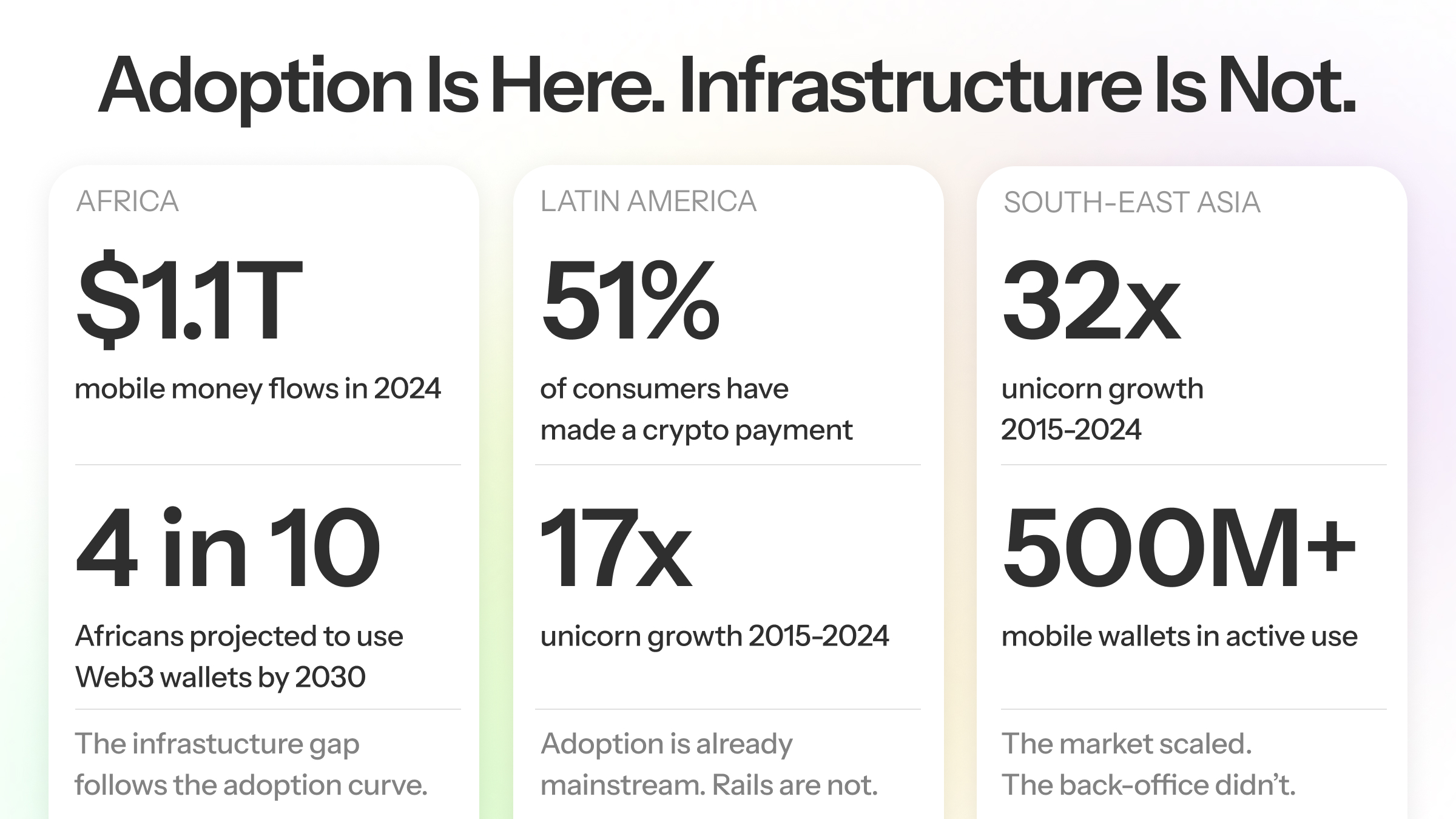
But adoption at the treasury layer is not the same as operational integration. A business that holds USDC as its primary treasury asset is still dependent on the same fiat rails, the same offramps, and the same regional banking infrastructure it was before. Adoption of the asset has outpaced the development of the operational infrastructure around it.
This gap is where operational friction concentrates. It is not a problem that better access to capital will resolve, because capital was not the constraint. The constraint is the reliability and predictability of the infrastructure through which capital moves: the accounts, the rails, the controls, and the reporting layer that makes it possible to operate a business at scale.
The next phase of adoption is not only about more capital reaching emerging markets. It is also about what happens after the money arrives, and whether the infrastructure is in place to turn funding into execution.
Capital Is the Precondition. Rails Are the Product.
For emerging market founders building with crypto and fiat simultaneously, the operational question is not just about where the money comes from. It is whether the infrastructure exists to deploy it reliably: to pay a supplier in a different country, to convert and distribute payroll on schedule, to maintain visibility across multiple currencies and accounts, and to do all of this without building a custom operations function from scratch.
That infrastructure, a reliable bridge layer across accounts, rails, controls, and reporting, is what determines whether capital translates into growth. The funding gap was always the more visible problem. The rails gap is the one that shapes what funded businesses can actually do.