Most conversations about debanking focus on the policy question: whether it is fair, whether it is legal, whether regulators have overstepped. Those questions matter. But for a founder running a crypto-native business, the more immediate question is operational: what actually breaks when a core bank account is closed or frozen, and how badly does it set you back?
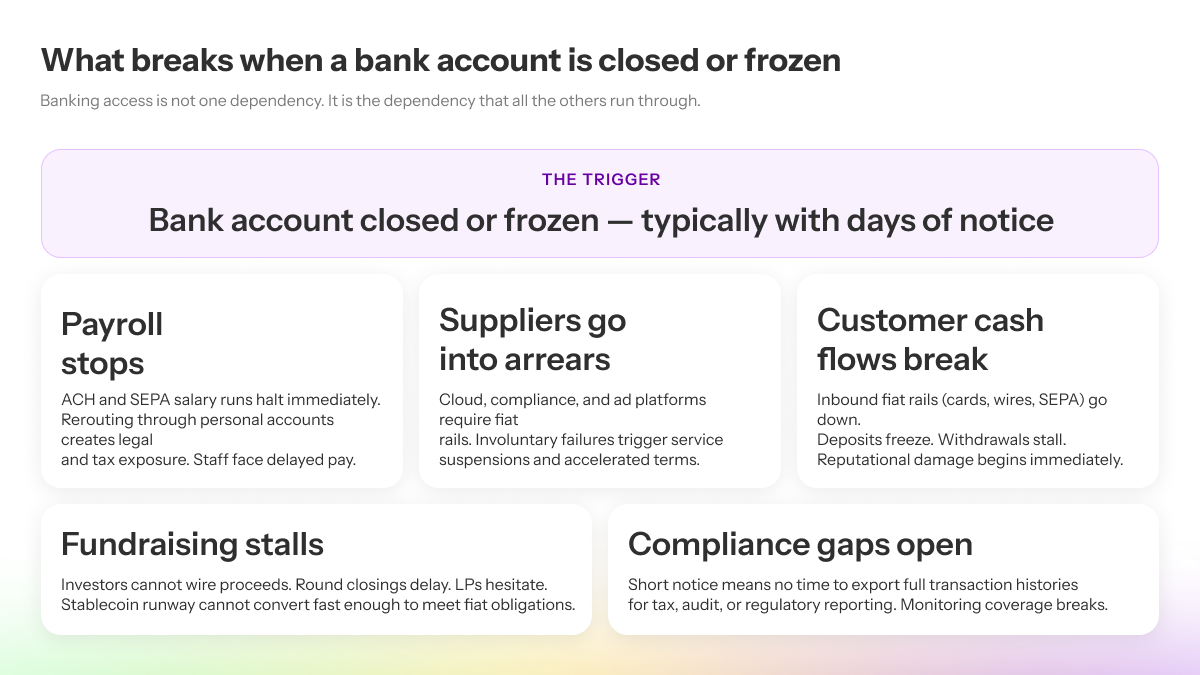
The answer is more severe than most people anticipate before they experience it. Banking access is not one dependency. It is the dependency that all the others run through. Payroll, supplier payments, customer receipts, fundraising, tax filings, compliance reporting — the list of things that stop working when a bank account disappears is long. Elliptic’s analysis of the de-risking paradox documents what happens when legitimate businesses lose access without warning: emergency rerouting of payments, manual patching of reconciliations, renegotiation of vendor terms, and a scramble to open replacement accounts, all while trying to run a company. The disruption is not theoretical. It is operational, and it compounds quickly.
How Widespread the Problem Is
Debanking of crypto businesses is now documented as a systemic pattern rather than a set of isolated incidents. In the UK, a January 2026 report from the UK Cryptoasset Business Council found that around 40 percent of transfers to major crypto exchanges are blocked or delayed by UK banks, with 80 percent of surveyed exchanges reporting rising customer payment friction. One exchange alone reported nearly one billion pounds in declined transactions over the prior year. Seventy percent of respondents said the banking environment was becoming more hostile, and 70 percent said it was reducing their willingness to invest, scale, or hire in the UK. These are not struggling startups. Several are FCA-registered businesses operating legally.
In the US, FOIA litigation by Coinbase forced the FDIC to disclose internal communications showing that regulators had pressured banks to limit or halt services to crypto businesses. In December 2025, the OCC published preliminary findings that nine of the largest US banks had imposed unjustified restrictions on lawful crypto businesses, often citing “reputational risk” rather than any specific compliance concern. The FDIC subsequently settled with Coinbase for $188,000 and committed to revising its disclosure practices, an institutional acknowledgment that prior supervisory pressure had existed. In Europe, industry surveys suggest that the large majority of crypto businesses — on the order of 80 to 90 percent — have faced repeated account denials or closures when seeking basic payment and merchant services, even post-MiCA.
The pattern is global. Nigeria formally reversed its banking ban on crypto businesses in December 2023, but access now depends on meeting detailed compliance requirements that banks apply inconsistently. Indonesia transferred crypto oversight to its financial regulator in January 2025, creating clearer licensing pathways but still leaving banking access contingent on regulatory status that most smaller operators cannot quickly obtain. As Freshfields’ 2025 regulatory roundup notes, debanking is now treated as a structural risk factor for the sector rather than an anomaly.
What Actually Breaks
The operational blast radius of losing a primary bank account is wider than most founders plan for. It is useful to think through the specific failure modes rather than treating debanking as a generic “disruption.”
Payroll stops first. Salary payments typically run through ACH or SEPA from the primary operating account. A freeze halts payroll entirely. Rerouting through a director’s personal account raises immediate employment law, tax, and anti-money-laundering concerns. Even companies paying part of their team in stablecoins still have fiat obligations: tax, benefits, and local statutory requirements that cannot be settled onchain. A banking outage surfaces as employee churn and legal exposure faster than almost any other consequence.
Suppliers go into arrears. Cloud providers, compliance vendors, payment processors, and advertising platforms typically require fiat payment rails. Most will not accept stablecoins. Involuntary payment failures trigger service suspensions and accelerated terms. For a B2B payments or foreign exchange business, a banking cut-off instantly strands client funds and creates contractual breach exposure, not just operational inconvenience.
Customer cash flows break. Exchanges and onramp/offramp providers lose inbound fiat rails — cards, SEPA transfers, wires — when banking relationships are severed. This creates immediate revenue loss, frozen customer balances, and reputational damage around withdrawal issues. Even at the level of payment delays rather than full account closure, the UKCBC data shows this affects growth directly: blocked transfers reduce deposit volumes, undermine user trust, and slow acquisition in ways that compound over months rather than resolving quickly.
Fundraising stalls. Investors wire fiat proceeds into regulated bank accounts. An inability to receive or promptly distribute funds delays closing rounds, forces workarounds through special purpose vehicles, or causes limited partners to hesitate. A business holding meaningful runway in stablecoins but lacking fiat offramps faces real insolvency risk if it cannot convert quickly enough to meet fiat-denominated obligations.
Compliance and reporting gaps open. Account closures typically happen with minimal notice and no right of appeal — days or weeks rather than months. This leaves insufficient time to export complete transaction histories and statements needed for tax filings, regulatory reporting, and audits. Businesses that have integrated bank data into automated compliance workflows suddenly lack reliable transaction monitoring coverage for that rail, creating supervisory exposure at exactly the wrong moment.
What Has Changed — and What Has Not
The US regulatory environment has shifted meaningfully at the policy level. In August 2025, President Trump signed an executive order directing federal banking regulators to review supervisory practices that had led to the debanking of lawful businesses including crypto firms, and to refer cases of unlawful debanking to the Attorney General. The OCC followed with preliminary findings in December 2025 naming nine of the largest US banks as having imposed unjustified limitations on crypto businesses. The FDIC acknowledged through its settlement with Coinbase that prior supervisory pressure had existed. PwC’s December 2025 regulatory update captures the shift: agencies are now expected to justify debanking patterns and avoid reputational-risk-only rationales for blanket restrictions.
What has not changed, at least not yet, is the lived experience of most crypto-native businesses trying to open or maintain bank accounts. Large banks remain risk-averse and selective. The narrow set of banks and fintech platforms that were crypto-tolerant before the executive order are still the same narrow set in early 2026. Approval rates for small and mid-sized crypto businesses at major banks have not demonstrably normalised. The regulatory backdrop is more supportive. The ground-level reality is more cautious.
Outside the US, the picture is more mixed. In the UK, the data shows the situation getting worse in 2025 and 2026, not better, despite FCA registration being a real and meaningful regulatory credential. In the EU, MiCA has increased institutional participation and cross-border activity, but smaller crypto-native businesses in certain member states still find banking access restricted despite holding valid registrations. In emerging markets, the shift from outright bans to conditional access represents progress, but conditional access still means fragile access.
What a More Resilient Stack Looks Like
This is not a guide to getting rebanked. It is worth being honest that there is no straightforward workaround to the structural problem of banking access for crypto-native businesses. What does exist is a set of design choices that reduce the blast radius when banking disruption happens, and it will happen, for most crypto-native businesses, at some point.
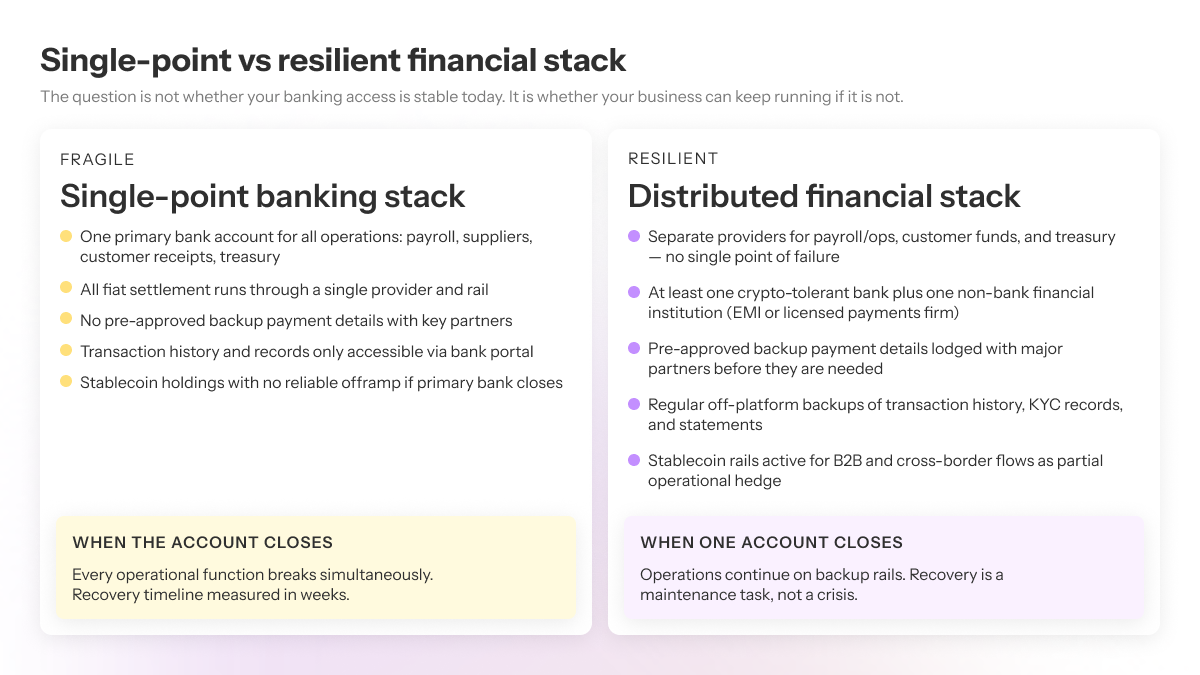
Multi-provider, multi-rail architecture. Maintain relationships with more than one bank and at least one non-bank financial institution — an electronic money institution or licensed payments firm — in each critical currency. Segment functions deliberately: one provider for payroll and general operating expenses, another for customer funds and settlement, another for treasury reserves. A single account closure should not halt all operations simultaneously. This is not complexity for its own sake. It is the same logic that drives redundancy in cloud infrastructure.
Crypto-native and crypto-tolerant institutions. Regulated crypto-friendly banks — Sygnum, SEBA, FV Bank — saw meaningful inflows when Silvergate, SVB, and Signature exited the market in 2023. They position themselves specifically for exchanges, over-the-counter desks, and asset managers who cannot get adequate service from traditional banks. US-focused startups commonly pair fintech platforms like Mercury with at least one traditional banking relationship. These combinations are not perfect, but they provide more resilience than a single primary account.
Stablecoins as a partial hedge. Stablecoins reduce dependence on domestic settlement rails for B2B and cross-border payments, and can keep parts of the business operational during a banking disruption. They are not a full substitute: payroll taxes, most vendor payments, and all interactions with counterparties who cannot accept onchain settlement still require fiat accounts. But a business that has built stablecoin rails into its payment infrastructure is meaningfully more resilient than one that runs entirely through a single bank account.
Operational readiness. Maintain pre-approved alternative payment details with major partners before you need them. Keep regular off-platform backups of transaction histories, statements, and KYC records so that a sudden portal shut-off does not also create a compliance crisis. Know which accounts would absorb payroll and supplier payments if the primary account was suspended tomorrow. These are not dramatic preparations. They are the financial equivalent of a runbook — the kind of operational documentation that any well-run business maintains for its most critical infrastructure.
The Bigger Picture
Debanking is often framed as a fairness problem or a political problem. For the businesses experiencing it, it is a growth problem. A company that loses its primary bank account at month 18 of a growth trajectory — after raising a Series A, after hiring a team, after committing to customers and vendors — is not dealing with an inconvenience. It is dealing with a potential existential event that plays out across payroll, suppliers, customers, investors, and regulators simultaneously, on a timeline set by the bank, not by the business.
The regulatory environment is improving in parts of the world. But improvement at the policy level translates slowly into improvement at the operator level. Until banking access for crypto-native businesses is as reliable as banking access for any other lawful industry, the design of the financial stack — how many providers, which rails, what redundancy — is not a back-office question. It is a business continuity question. And as Phemex’s analysis of systemic debanking notes, the businesses that treat it as such before they need to are the ones that keep running when it happens.