
KYB is not a gate that opens once. It is a recurring operational cost that compounds as the business adds banking relationships, enters new payment corridors, launches new products, onboards enterprise customers, and grows its transaction volume. Every one of those moves triggers new verification requirements, and the data collected for one provider rarely transfers cleanly to the next. The result is a growing inventory of compliance relationships, each on its own refresh cycle, each requiring ongoing maintenance that does not appear in any payment infrastructure budget but absolutely appears in compliance headcount.
Why KYB Keeps Recurring
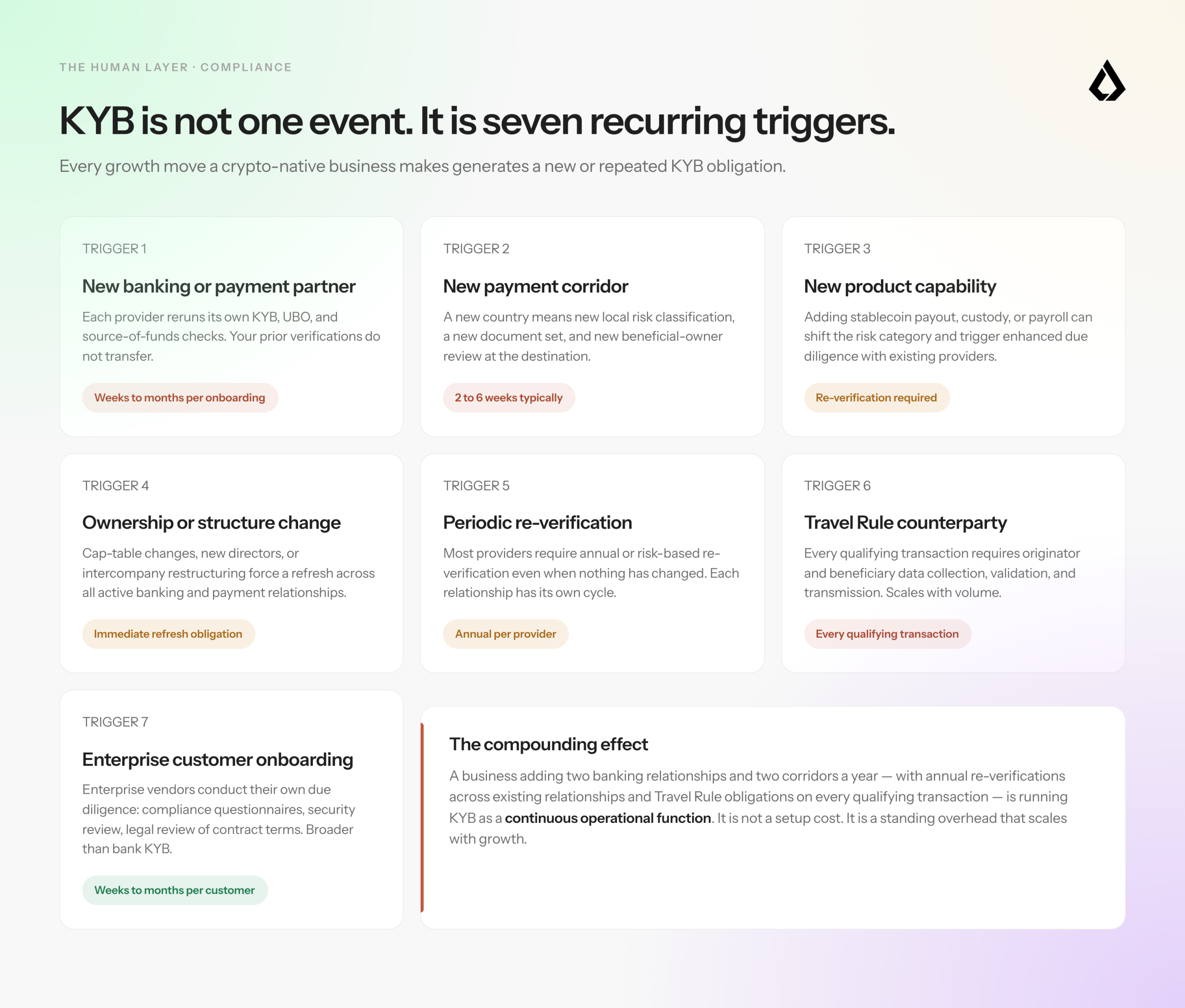
The triggers for new or repeated KYB are numerous and predictable. A new banking or payment partner runs its own know-your-business verification regardless of what other providers have already verified; each institution applies its own risk model, document requirements, and beneficial-owner review. A new payment corridor often means a new local risk classification and a new document set. Adding a new product capability — stablecoin payout, custody, payroll — can push the relationship into a higher-risk category that triggers enhanced diligence. Changes in ownership, corporate structure, or directorship typically require a refresh. And most providers require periodic re-verification on an annual or risk-based cycle even when nothing has materially changed. KYB compliance guidance for crypto companies frames this clearly: KYB is not done after launch. It recurs whenever the business expands its banking surface area, changes its risk profile, or needs to pass a new counterparty's controls.
For a business moving through its second and third year of operations — adding corridors, adding banking relationships, changing product mix — the aggregate KYB workload is materially larger than the founding team anticipated. Each individual instance is manageable. Together they constitute a standing function that requires dedicated resource.
The Data Portability Problem
KYB data is not portable. A business that has completed thorough verification with one provider cannot present that outcome to the next provider and skip the process. Each institution asks for the same underlying facts — legal entity name, incorporation documents, ultimate beneficial owners, source of funds, expected transaction volumes — but wants them in its own format, within its own freshness window, mapped to its own risk questionnaire. The overlap between what providers require is real but partial. Research on KYB for stablecoins documents this precisely: core artifacts like incorporation documents and UBO identities carry over, but beneficial-owner control narratives, source-of-funds explanations, and provider-specific risk questionnaires have to be reworked each time.
The practical cost is re-onboarding friction at scale. A business that has established KYB relationships with five banking or payment providers, and that adds two more per year as it expands corridors, is running a continuous re-onboarding process in parallel with its core operations. Banking industry analysis of KYB digitisation documents KYB as involving dozens of process steps and material per-onboarding cost, with annual re-verification adding a recurring layer on top. There is no equivalent of a credit bureau for business compliance history — no portable KYB passport that a business can present and have accepted across counterparties. Every relationship starts from the beginning.
The business has already proven what it is. It just has to prove it again, in a different format, to a different counterparty, on a different timeline. And then again after that.
The Travel Rule Adds a Second Layer
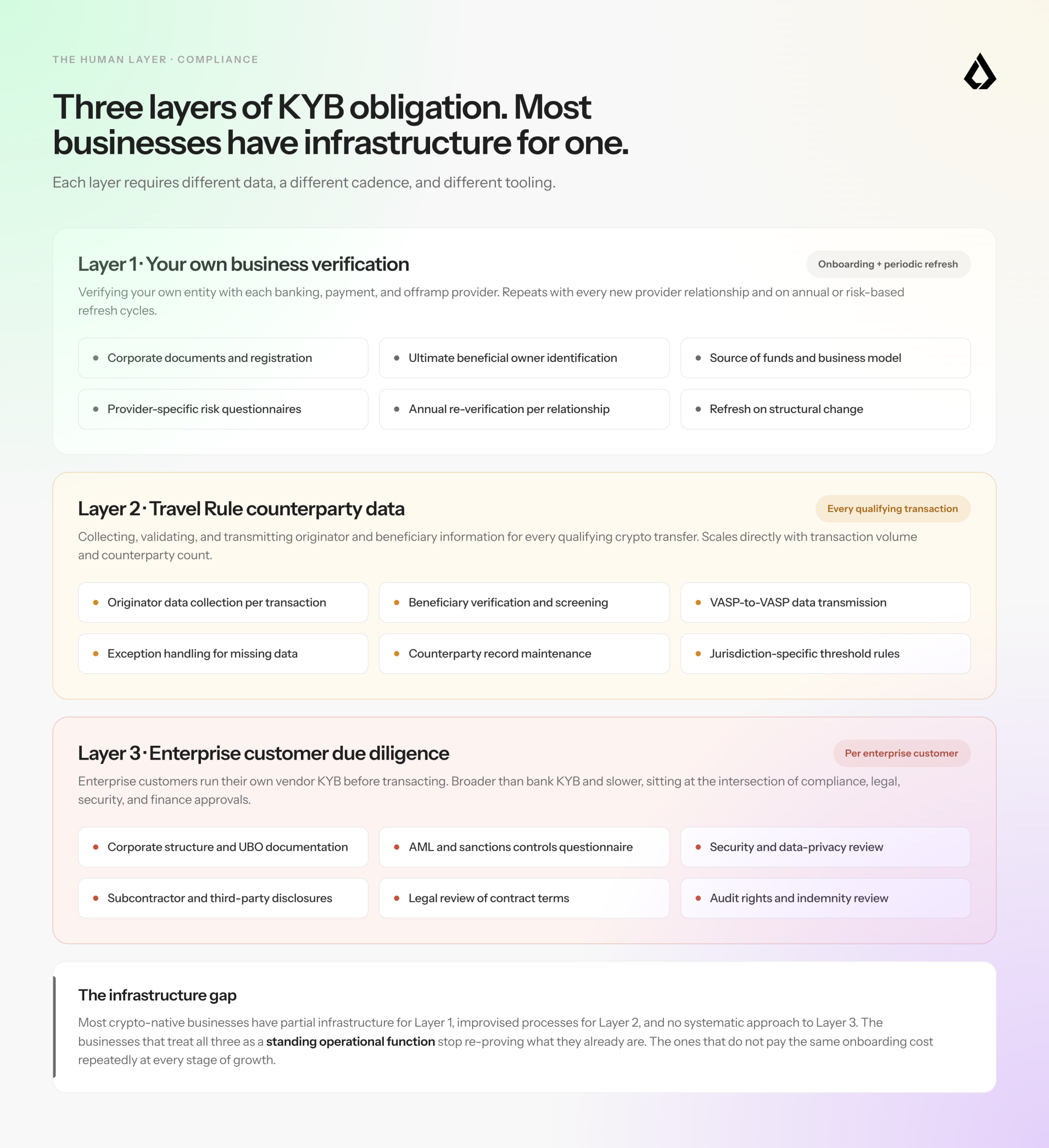
The Travel Rule transforms KYB from an onboarding obligation into a transaction-by-transaction one. For qualifying crypto transfers — which in most FATF-aligned jurisdictions means virtually all B2B payment flows above a low threshold — the business must collect, validate, transmit, and store originator and beneficiary information for every counterparty in every transaction. It is not enough to have verified your own business once. Every counterparty you transact with creates a new data obligation, and that obligation scales directly with transaction volume and counterparty count. Notabene's Travel Rule compliance overview describes this dynamic clearly: more counterparties means more KYB records to maintain, more transactions means more messages to transmit and more exceptions to resolve, and more jurisdictions means more policy variations to navigate.
Enforcement is now live across the EU under MiCA, in Singapore under MAS, in the UAE under CBUAE, and across a widening set of FATF member jurisdictions. Travel Rule compliance requirements for VASPs documents the operational overhead this creates: counterparty data collection, screening, exception handling when data is incomplete or mismatched, and audit logging on every relevant transfer. This is not a one-time compliance investment. It is a standing operational function whose cost is proportional to payment volume.
The consequence is a second KYB layer that the business did not budget for when it designed its compliance stack. The first layer covers the business itself, verifying its own identity and structure with providers. The second layer covers every counterparty it transacts with, at transaction frequency. Both layers require infrastructure to manage. Most businesses have partial infrastructure for the first and improvised processes for the second.
Enterprise Customers Add a Third
When a crypto-native business tries to serve enterprise customers, the enterprise runs its own due diligence process, and that process is broader and slower than what a bank or payment provider requires. Enterprise vendor due diligence typically covers corporate structure and UBO documentation, sanctions and AML controls questionnaires, security and data-privacy reviews, subcontractor and third-party risk disclosures, and legal review of contract terms including indemnities and audit rights. Supplier due diligence frameworks notes that the enterprise vendor process is not only about whether the business is permitted to exist. It is about whether the vendor can be safely embedded into procurement, accounts payable, and audit workflows.
The consequence is that a crypto-native business can pass bank KYB and VASP licensing requirements and still stall in enterprise procurement because the customer's internal compliance, legal, and security teams cannot map the vendor's controls to their own policies. This is not a solvable problem through better documentation alone; the enterprise due diligence process is extensive by design and does not compress easily. For a business trying to grow its enterprise revenue, vendor onboarding can add weeks or months to a sales cycle that was otherwise complete.
What Good Infrastructure Actually Requires
The businesses that manage KYB complexity well have accepted that it is an infrastructure problem, not a form-filling one. The structural choices that distinguish them follow a consistent pattern. KYB in crypto: compliance infrastructure patterns describes the common approach: a centralised KYB repository that holds corporate documents, UBO records, counterparty files, and refresh dates in one place; a standardised intake workflow that collects the superset of what any likely provider might require; automated monitoring for document expiry and ownership changes; and Travel Rule infrastructure that handles counterparty data transmission without manual re-entry for each transaction.
What separates this from the alternative is not the quality of any individual piece. It is whether the data stays current across all relationships simultaneously. A business that has excellent KYB documentation at onboarding but no system for tracking when documents expire, when ownership changes, or when a provider's requirements have shifted is not managing KYB as infrastructure. It is managing it as a series of individual events, and discovering the gaps when a provider freezes limits or an enterprise deal stalls in procurement.
The market for KYB and Travel Rule tooling is mature enough to support better infrastructure than most businesses have built. The gap is not the absence of vendors. It is that KYB has not been treated as a first-class operational function with its own ownership, tooling, and service levels. The businesses that close that gap stop re-proving what they already are. The ones that do not keep paying the same onboarding cost, repeatedly, at every stage of growth.