
On- and off-ramps are the bridges between fiat money and crypto.
Getting into crypto is easy. You start with money you already have, using a bank transfer, a card payment, or sometimes a local payment app. The transaction goes through and crypto shows up in your wallet. This first step is called an on-ramp.
You pay for it in small ways thrugh fees, spreads, and processing costs. Nothing breaks, but some value leaks on the way in. Once the funds arrive, attention shifts quickly because the onchain world usually works the way it promises.
Transfers settle fast and costs stay low. Assets can be swapped, staked, or put to work in liquidity pools. As value accrues, the next step is bringing it back into the real world.
Paying expenses, moving funds into a bank account, and closing the loop requires an off-ramp. This is where things slow down again. Checks increase, fees rise, and reporting becomes more precise. The same system that feels efficient onchain becomes heavy at the edges.
Cheap Onchain, Expensive at the Door
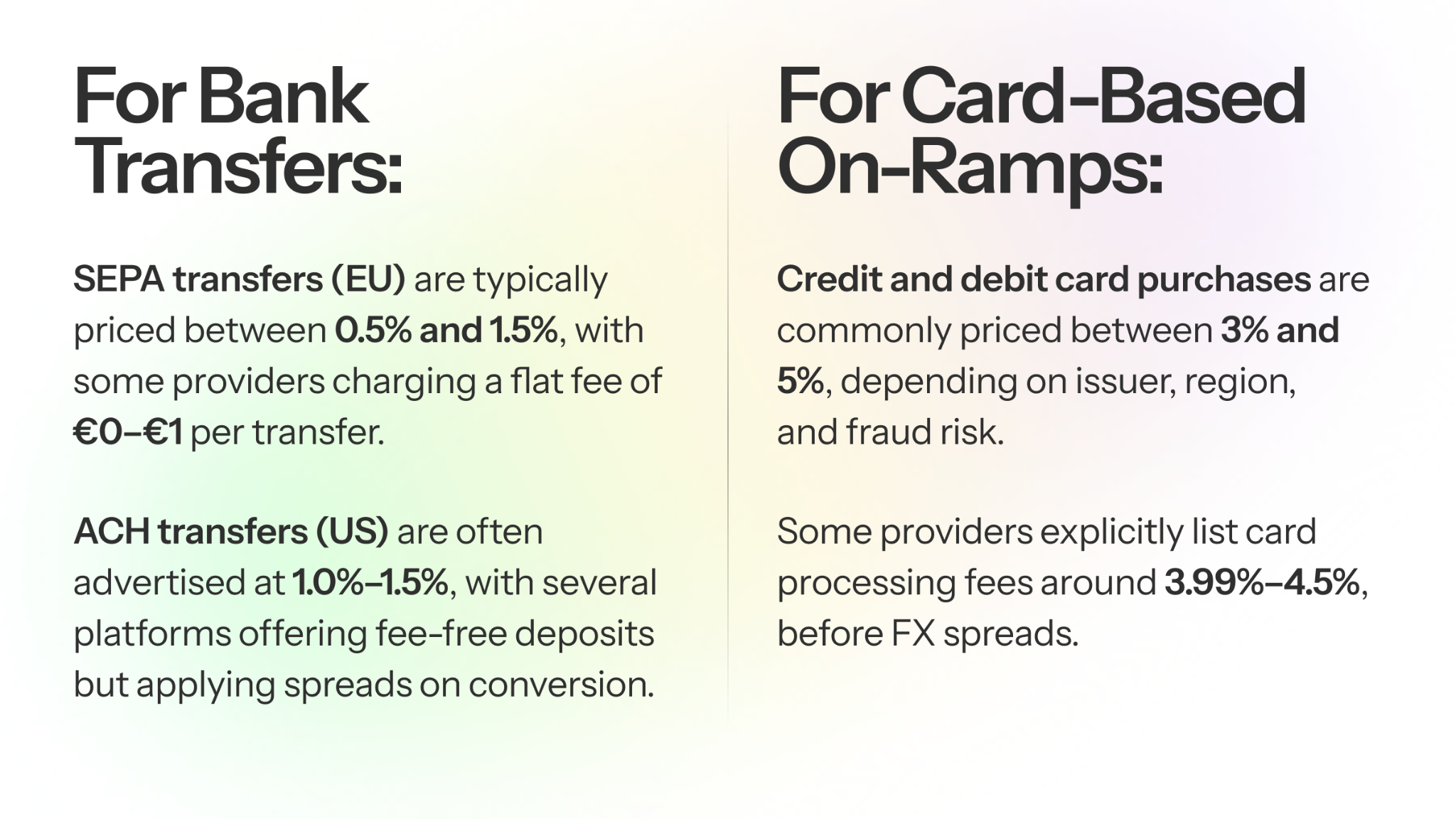
Publicly disclosed pricing from major on-ramp providers shows a clear and consistent pattern: bank transfers are the cheapest way to enter crypto, while cards are the most expensive.
For bank transfers:
- SEPA transfers (EU) are typically priced between 0.5% and 1.5%, with some providers charging a flat fee of €0–€1 per transfer.
- ACH transfers (US) are often advertised at 1.0%–1.5%, with several platforms offering fee-free deposits but applying spreads on conversion.
For card-based on-ramps:
- Credit and debit card purchases are commonly priced between 3% and 5%, depending on issuer, region, and fraud risk.
- Some providers explicitly list card processing fees around 3.99%–4.5%, before FX spreads.
These fees are almost always applied on top of the payment rails themselves, where card processing costs are treated differently from bank transfers.
Additionally, the advertised fee is rarely the full cost. Fiat-to-crypto conversion often includes an FX spread of 0.5%–2%, which is not always shown upfront. In addition, users may pay onchain network fees once funds are delivered to a self-custodial wallet. The effective cost of entering crypto can therefore exceed the headline percentage, especially for smaller transactions or less liquid currencies.
Entry Costs Are Higher in Emerging Markets
Measured purely at the fiat rail level, emerging markets already face materially higher transaction costs before crypto is involved.
According to the World Bank Remittance Prices Worldwide (Q3 2024):
- Sub-Saharan Africa has an average inbound transfer cost of 7.4%
- Latin America and the Caribbean averages 5.8%
- East Asia and the Pacific averages 5.4%
- By comparison, Europe and Central Asia averages 4.1%
These figures include FX spreads, intermediary fees, and settlement costs across bank transfers, card payments, and mobile money corridors.
Crypto on-ramps operating in these regions rely on the same underlying rails. As a result, a user converting fiat to crypto in Sub-Saharan Africa is starting from a cost base roughly 3 percentage points higher than a user in Europe, before any crypto-specific fees, spreads, or onchain costs are applied.
This structural difference produces a consistent outcome: users in emerging markets face higher and more variable effective entry costs, even when using the same on-ramp providers and the same blockchain networks. While the blockchain layer itself is global and low-cost, the price of accessing it remains tightly bound to local currency liquidity, payment infrastructure, and FX efficiency.
Off-Ramps Introduce Higher Costs and Tighter Constraints
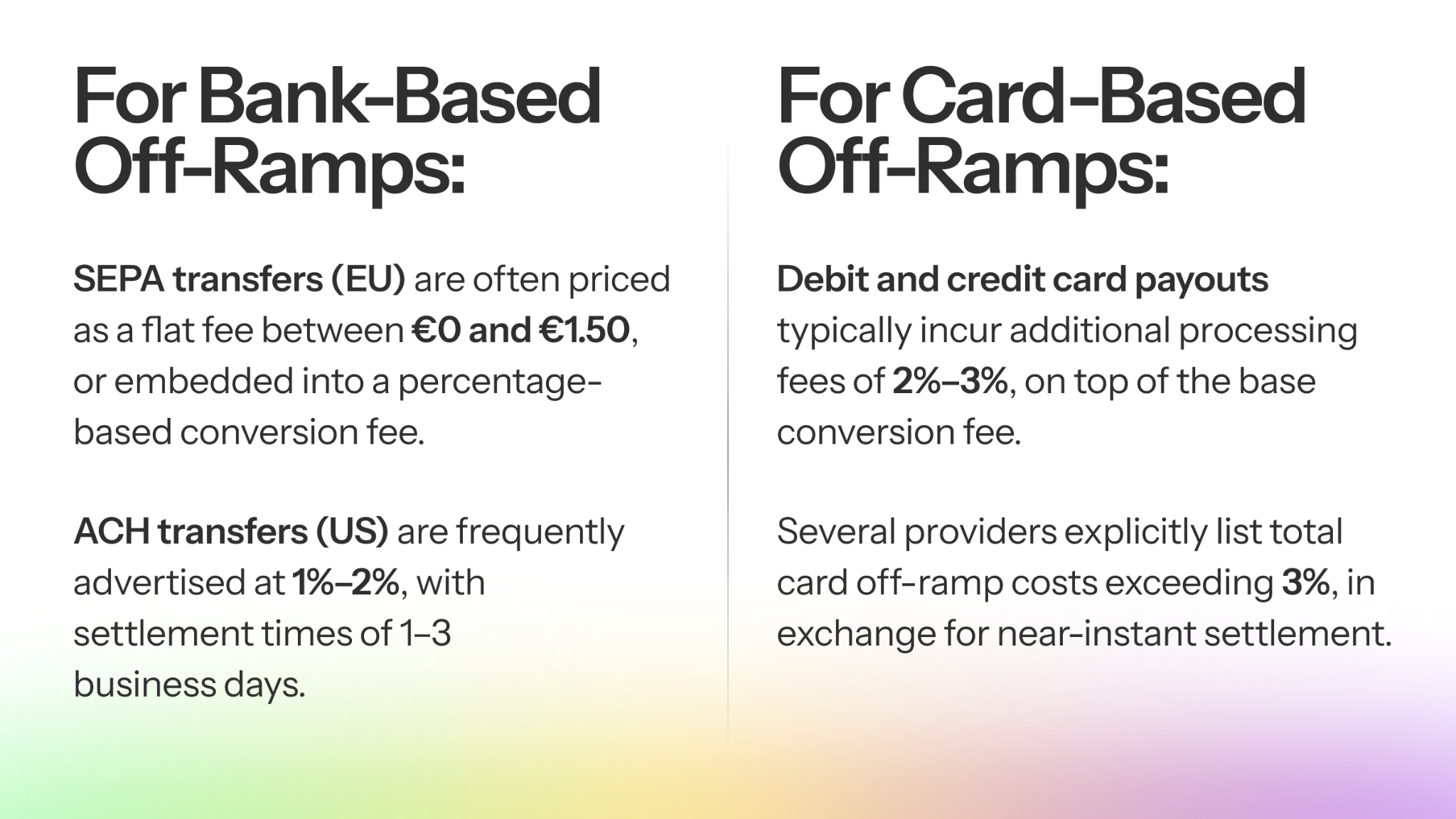
Crypto off-ramps convert digital assets such as BTC, ETH, or stablecoins into fiat currencies like USD or EUR, typically via bank transfers or card payouts. Unlike on-ramps, exiting crypto tends to trigger higher fees, slower settlement, and increased scrutiny, particularly as transaction size or frequency increases.
Publicly disclosed pricing from major off-ramp providers and exchanges shows that off-ramp fees commonly fall between 1% and 4% per transaction, depending on the asset, payout method, and settlement speed. Providers such as MoonPay, Transak, and exchange-native services like Kraken and Coinbase publish separate pricing for bank transfers and card-based withdrawals.
For bank-based off-ramps:
- SEPA transfers (EU) are often priced as a flat fee between €0 and €1.50, or embedded into a percentage-based conversion fee.
- ACH transfers (US) are frequently advertised at 1%–2%, with settlement times of 1–3 business days.
For card-based off-ramps:
- Debit and credit card payouts typically incur additional processing fees of 2%–3%, on top of the base conversion fee.
- Several providers explicitly list total card off-ramp costs exceeding 3%, in exchange for near-instant settlement.
Beyond explicit fees, off-ramps often apply exchange-rate spreads that are not shown separately from the headline price. These spreads increase the effective cost relative to spot prices, particularly in less liquid markets or during periods of volatility. In addition, users must pay onchain network fees to transfer assets to the off-ramp provider, which vary by blockchain and congestion.
The net effect is that converting crypto back into fiat is frequently more expensive and less predictable than entering crypto, even before accounting for withdrawal limits, enhanced compliance checks, or tax reporting obligations.
The Real Bottleneck Is Coordination
On- and off-ramps are often discussed as isolated services, but in practice they define how scalable crypto is in the real world. As activity grows, costs no longer come only from individual transactions, but from how many systems must be stitched together to make those transactions usable, compliant, and auditable.
This is where adoption tends to slow. Not because onchain systems are expensive or unreliable, but because value has to pass through a fragmented set of providers, each handling a narrow slice of the workflow. Payments, conversions, compliance checks, reporting, and reconciliation are treated as separate problems, even though they are tightly coupled in day-to-day operations.
As crypto moves from experimentation to sustained use—particularly in emerging markets—the missing piece is not another faster chain or cheaper swap. It is an operational layer that treats finance as a continuous process rather than a collection of handoffs. Bringing entry, exit, compliance, and reporting into a single, coherent system is not a convenience feature; it is what makes scale possible.
Crypto may be global by design, but adoption depends on how well it integrates with the realities of local finance. Solving that integration is what ultimately turns infrastructure into usage.