
What most are experiencing is the permanent operational reality of running in two financial systems simultaneously. The crypto-native layer — stablecoins, onchain wallets, programmable settlement — handles an increasing share of how value actually moves. The traditional financial layer — banks, fiat accounts, SWIFT, auditors, investors, enterprise customers, regulators — handles an equally persistent share of what the business has to satisfy. These two systems have different logic, different speeds, different data formats, different compliance requirements, and different expectations about what a financial record looks like. The friction between them does not resolve as the business matures. It becomes more structured, more expensive to manage, and more consequential as the business grows.
This is not a problem that will be solved by better rails. Stripe's analysis of crypto B2B payments captures the dynamic precisely: accounting and tax authorities classify crypto as a digital asset rather than cash, investors expect GAAP or IFRS-compliant reporting, and enterprise customers require fiat invoicing and bank wire settlement, regardless of how the underlying treasury is run. The two systems coexist. The question is how much it costs to operate in both, and whether that cost is managed or absorbed.
Where the Two Systems Conflict
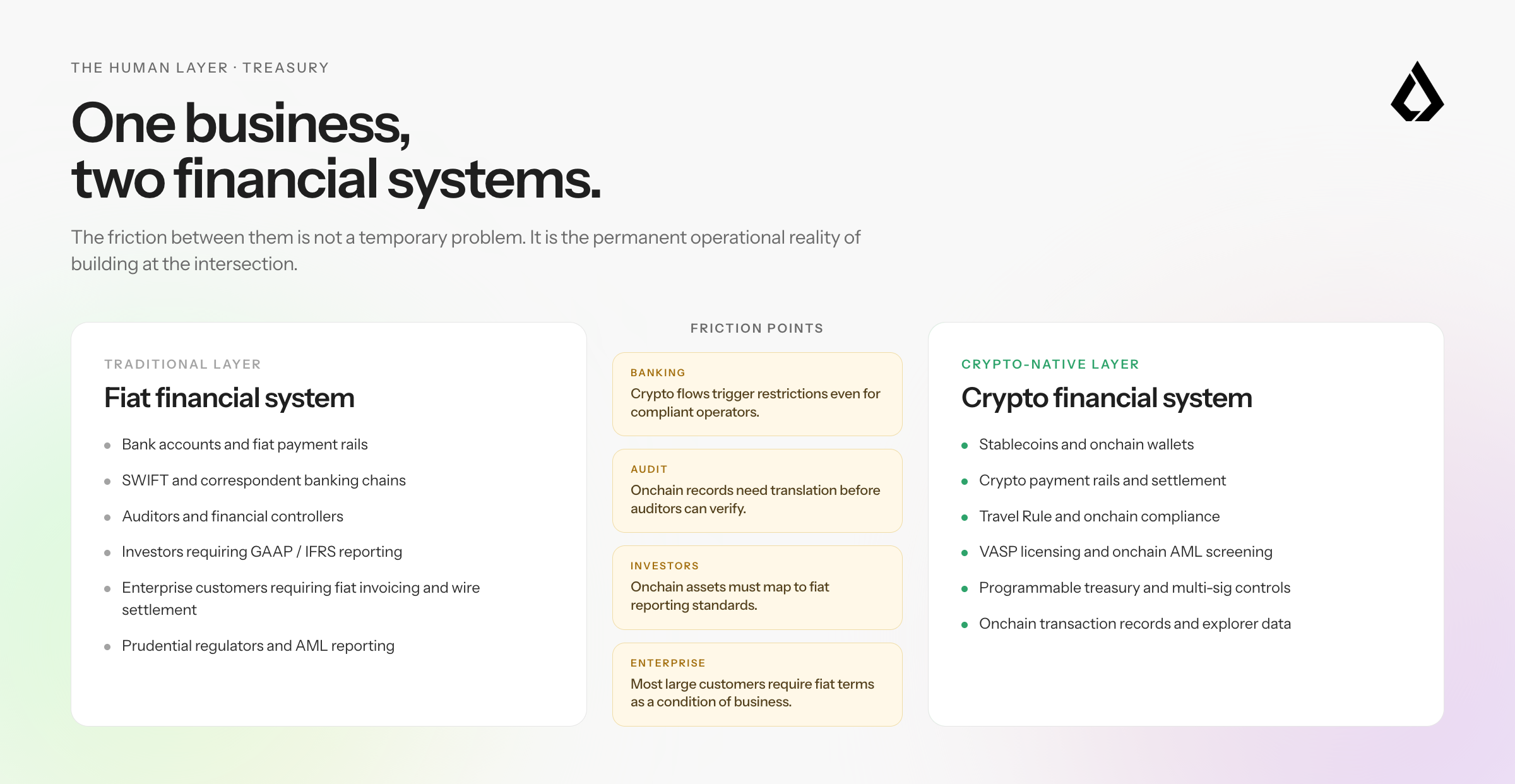
The conflicts between traditional and crypto-native financial infrastructure are not abstract. They show up in specific, recurring operational moments.
Banking relationships. Most banks still treat stablecoin activity as elevated risk. Payments to exchanges and onchain wallets trigger enhanced documentation requirements, manual reviews, and occasionally account restrictions, even when the underlying business is fully compliant and the transactions are straightforward. BVNK's analysis of cross-border payments documents this directly: payment providers classify stablecoin flows as higher risk, creating slower payouts and operational friction for otherwise low-risk B2B operators. A business that runs treasury in stablecoins still depends on traditional banking relationships for payroll, tax, supplier payments, and fundraising, and those relationships are maintained under terms set by institutions that view the crypto activity with suspicion.
Auditors and financial controllers. Auditors trained on fiat ledgers typically lack the tooling and familiarity to interpret raw onchain activity. Finance teams at crypto-native businesses have to normalise wallet data — transaction hashes, wallet addresses, timestamp-matched valuations — into traditional ledger entries before an audit can proceed. This produces a common situation: balances are provably correct onchain but effectively invisible or unverifiable in the enterprise resource planning system, forcing teams to maintain parallel records that have to be reconciled manually at every reporting cycle.
Investors and fundraising. Investors operate in the traditional financial system. They wire fiat, expect financial statements that conform to accounting standards, and require a clear mapping from every asset on the balance sheet to a legal entity. When a material share of a company's assets and revenue is onchain, due diligence extends if the company cannot quickly present an investor-grade view that reconciles onchain positions with fiat reporting. Stripe's stablecoin adoption research notes that investors often insist stablecoin balances be reported separately with clear valuation policies, or converted into fiat, precisely because the accounting treatment of crypto assets does not fit cleanly into the categories investors use to evaluate companies.
Enterprise customers. Large businesses expect fiat invoicing, net payment terms — Net-30, Net-45, Net-60 — purchase orders, and bank wire settlement, all documented in formats compatible with their own accounting systems. Cobo's enterprise guide to B2B crypto payments describes a growing cohort of upper-mid-market suppliers who will accept stablecoin payment terms, particularly for early-payment discounts, but notes that most large enterprise customers still require traditional invoicing and fiat settlement as a condition of doing business. A crypto-native vendor serving enterprise customers is therefore maintaining two parallel commercial workflows: a crypto-native track for customers who can operate on those terms, and a traditional fiat track for the majority who cannot.
The operational environment never collapses into a single system. It just gets better or worse instrumented.
The Compliance Cost of Running Both
Satisfying both financial systems simultaneously means complying with two partially overlapping but non-identical regulatory regimes. Traditional fiat rails bring e-money, payments, and banking regulations: know-your-customer and know-your-business requirements, anti-money-laundering monitoring, sanctions screening, suspicious activity reporting, and capital safeguarding rules. Crypto rails add virtual asset service provider licensing, Travel Rule compliance, onchain transaction screening, and in some markets specific disclosures or limits on digital assets.
The compliance consequence is not simply additive, it is architectural. Flagright's analysis of unified compliance for fiat and stablecoin payments documents the common pattern: businesses run one monitoring and case-management system for bank transfers and a separate stack for onchain analytics and Travel Rule messaging. Analysts then reconcile alerts manually across the two systems. The result is inconsistent risk views, duplicate investigations, and higher operating costs. Unified compliance approaches are only now emerging and still require significant implementation work before they deliver the integration they promise.
The underlying problem is that neither system's compliance infrastructure was built for the other. Traditional compliance tooling cannot parse wallet clusters, smart-contract interactions, or chain-specific risk signals. Crypto-native compliance tooling does not model traditional banking concepts like correspondent chains, chargebacks, or batch file reporting to prudential regulators. A business running both rails needs both types of tooling, and someone whose job it is to stitch the outputs together into a coherent risk picture.
The Translation Tax
Every month and every quarter, a crypto-native business pays what might be called a translation tax: the operational cost of converting onchain reality into traditional financial reporting formats that investors, auditors, and regulators can interpret.
The mechanics of this translation are well-documented. Finance teams export transaction data from wallets, exchanges, and banks in incompatible formats, normalise them into something an accounting system can ingest, assign cost basis, foreign exchange rates, and general ledger categories to each transaction, and then reconcile the result against onchain balances that may have moved during the reconciliation process itself. Academic research on blockchain and financial reporting suggests that integrated reporting architectures — where the onchain subledger and the fiat general ledger are tightly connected — can reduce financial reporting operating costs by 15 to 20 percent and audit costs by 25 to 30 percent. Getting there requires substantial upfront investment in integration and process redesign that most businesses are still making.
The scale of the manual effort without that integration is significant. Research on high-volume operations — businesses processing around 50,000 daily onchain transactions — documents finance teams spending roughly 40 hours per week on manual reconciliation before implementing a dedicated crypto subledger, a separate system that tracks onchain transactions in detail before posting summarised entries to the main accounting system. After implementation, that fell to under five hours per week with reconciliation accuracy improving to 99.8 percent. That is the cost of not having the connective tissue in place, the equivalent of a full-time role consumed by translation rather than analysis.
For businesses at smaller transaction volumes, the manual approach is more manageable, until it is not. The translation tax does not stay constant as the business grows. It scales with transaction volume, with the number of onchain venues, and with the complexity of the entity structure. A business that manages it manually at 20 transactions a day hits a wall at 2,000. Stripe's crypto B2B payments analysis notes that misalignment between onchain timestamps and bank settlement dates alone creates foreign exchange revaluation complexity that compounds across reporting periods — a specific, recurring translation problem that has no good manual solution at scale.
What Businesses That Manage This Well Actually Do
The businesses that operate across both financial systems without constant friction have made similar structural choices, almost universally. None of them solved the problem by eliminating one system. All of them built connective tissue.
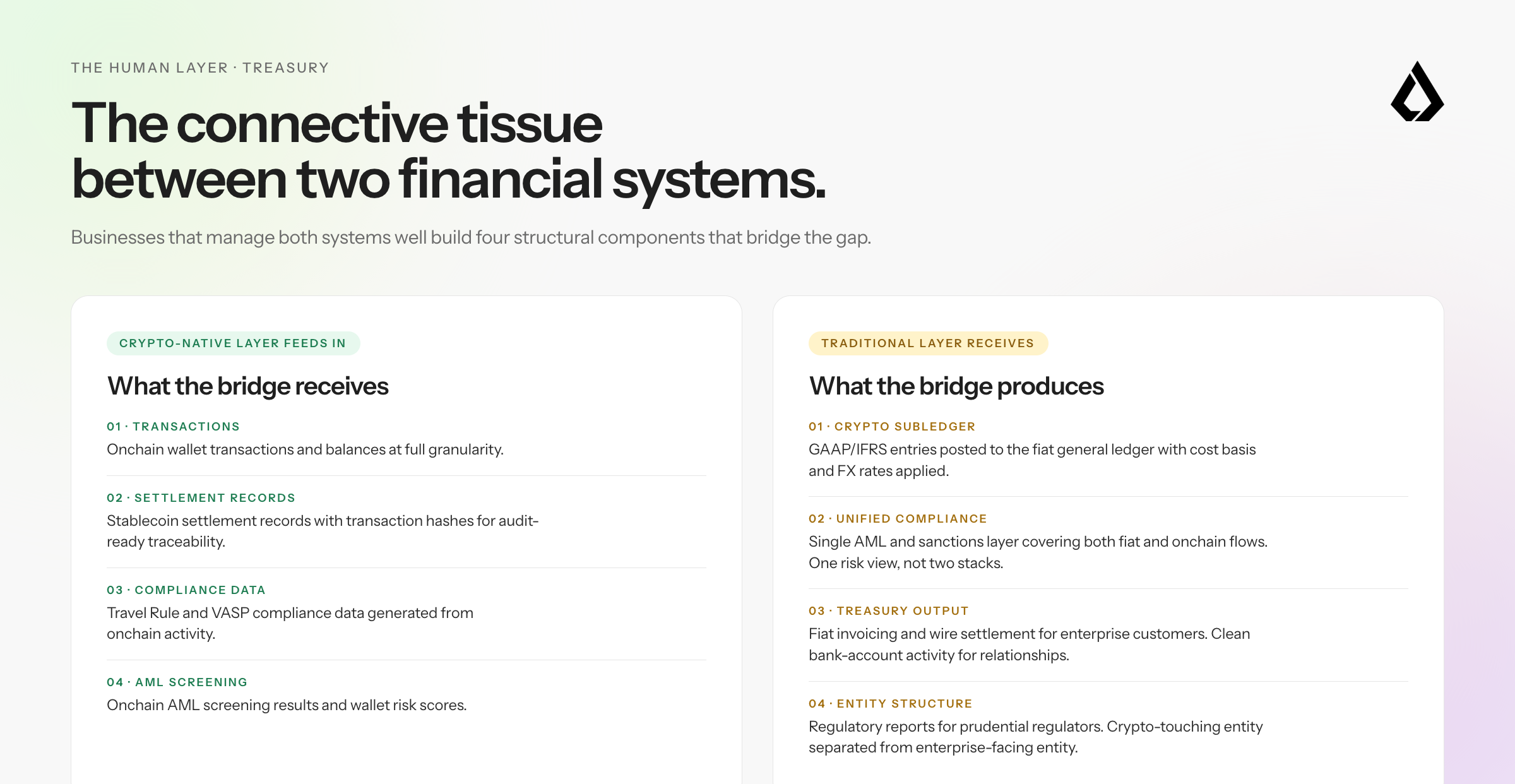
Dedicated treasury and subledger architecture. Rather than trying to force either the fiat general ledger or the onchain record to carry the full accounting load, effective operators maintain a dedicated crypto subledger that tracks onchain activity at the required granularity and posts summarised, properly classified entries to the main accounting system. Phoenix Strategy Group's analysis of blockchain B2B payments describes the pattern: a treasury platform that can create payments, convert between fiat and stablecoins, pay vendors, and then reconcile the result, with integrations ensuring that both the crypto layer and the fiat accounting system see a coherent picture.
Unified compliance infrastructure. Investing early in compliance tooling that covers both rails — a single sanctions screening, anti-money-laundering monitoring, and case management layer that handles both bank transfers and onchain flows — avoids the cost and risk of running two separate compliance programmes. Flagright's unified compliance framework documents this as one of the primary ways businesses reduce the headcount cost of dual-system compliance. Firms that build this early avoid building and then migrating two separate compliance stacks as they scale.
Entity and role design. Some operators separate the entity that interacts with onchain infrastructure from the entity that contracts with enterprise customers and investors in fiat, connecting the two through intercompany agreements. This protects the traditional-facing entity from the regulatory complexity of the crypto-facing entity while allowing the business to operate both rails. The finance and compliance teams that manage this well tend to treat the financial stack as product infrastructure, making decisions about wallets, exchanges, and banking relationships with reporting and regulatory implications in mind from the start, rather than discovering those implications later.
Customer segmentation. Rather than forcing all customers onto a single payment track, effective operators segment deliberately: crypto-native customers operate on onchain terms, enterprise customers operate on fiat terms, and an internal treasury layer — managed by the infrastructure choices above — connects the two sides. Stripe's stablecoin adoption analysis describes this as the dominant pattern among businesses that have successfully integrated crypto payments alongside traditional customer relationships: stablecoins enter the stack, but traditional rails and reporting remain the interface for customers who require them.
The businesses that manage both systems well design around the conflict. They do not try to force either world to carry the full load.
The Permanent Reality
The two-system problem is not going to resolve itself as crypto matures. The trajectory is toward more businesses operating in both systems simultaneously, not fewer. Cobo's enterprise guide reports that B2B payments now account for around 60 percent of stablecoin transaction volume, with trillions settled in 2024 and 2025. The majority of those flows are layered on top of existing treasury and enterprise resource planning systems, not replacing them. Stripe and other mainstream payment providers have expanded stablecoin support while continuing automatic fiat settlement — productising the bridge where customers pay in stablecoins but merchants receive fiat, or vice versa. That is not convergence. That is institutionalisation of the dual-system reality.
For a crypto-native business, the implication is practical. The infrastructure decisions made at the start, which compliance tooling, which accounting architecture, which entity structure, which customer segmentation — are not setup costs that go away once the business is running. They are the connective tissue that determines how much the two-system operation costs every month, every quarter, and every time the business needs to present itself to investors, auditors, or enterprise customers. The businesses that treat those decisions as product investments rather than administrative overhead are the ones that find operating in both systems manageable. The businesses that defer them find the cost accumulating in places they did not budget for; reconciliation backlogs, compliance gaps, extended due diligence, and enterprise deals that move slowly because the financial records do not tell a clean story.
The two financial systems are not going to merge. The connective tissue between them is the operational challenge that defines crypto-native business infrastructure in 2026 and beyond.