The interesting question is what happens when the payment lands. Who proved the right person received it? How does the finance team record it in NetSuite? What happens when that contractor, clean at onboarding six months ago, appears on an updated sanctions list? Which jurisdiction gets the tax report, and in what form?
None of these questions live on the blockchain. They live in the back office, and the back office, in most stablecoin payroll operations today, is held together with CSV exports and manual matching. The payments layer is production-grade. The operations layer is not.
What the industry has actually solved
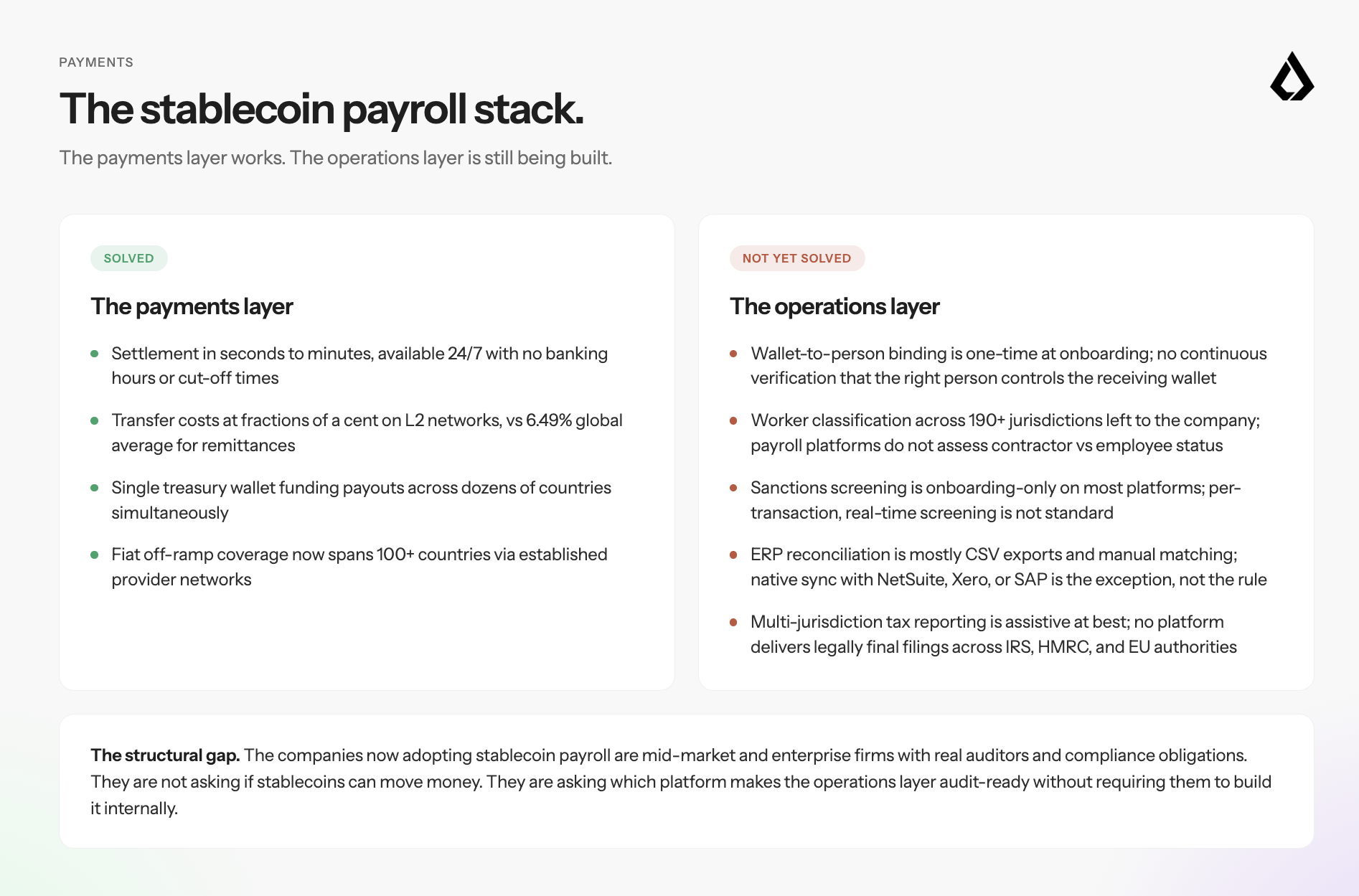
Credit where it is due. Stablecoin payroll has made genuine progress on the problems it set out to solve. Settlement that used to take two to five business days through SWIFT now takes seconds. Cross-border remittance fees that average 6.49% globally according to the World Bank Remittance Prices Worldwide Q1 2025 drop to fractions of a cent on L2 networks. Treasury teams can run payroll on their schedule, not their bank's. A single stablecoin wallet can fund payouts to dozens of countries without maintaining local bank accounts or pre-funded FX positions in each market.
For companies with globally distributed teams, particularly those paying contractors across emerging markets, this is a real operational improvement. Onchain payments reach workers in markets where traditional banking infrastructure is slow, expensive, or inaccessible.
But operational improvement and CFO-grade infrastructure are different things. The payments layer is fast. The question is whether everything around it can survive an audit.
The gap no one builds for: wallet-to-person binding
Every payroll system needs to answer a basic question: did the right person receive the money? In traditional payroll, the answer is straightforward. Bank accounts are tied to verified identities through the banking system's KYC infrastructure. The employer sends money to an account; the bank ensures the holder is who they say they are.
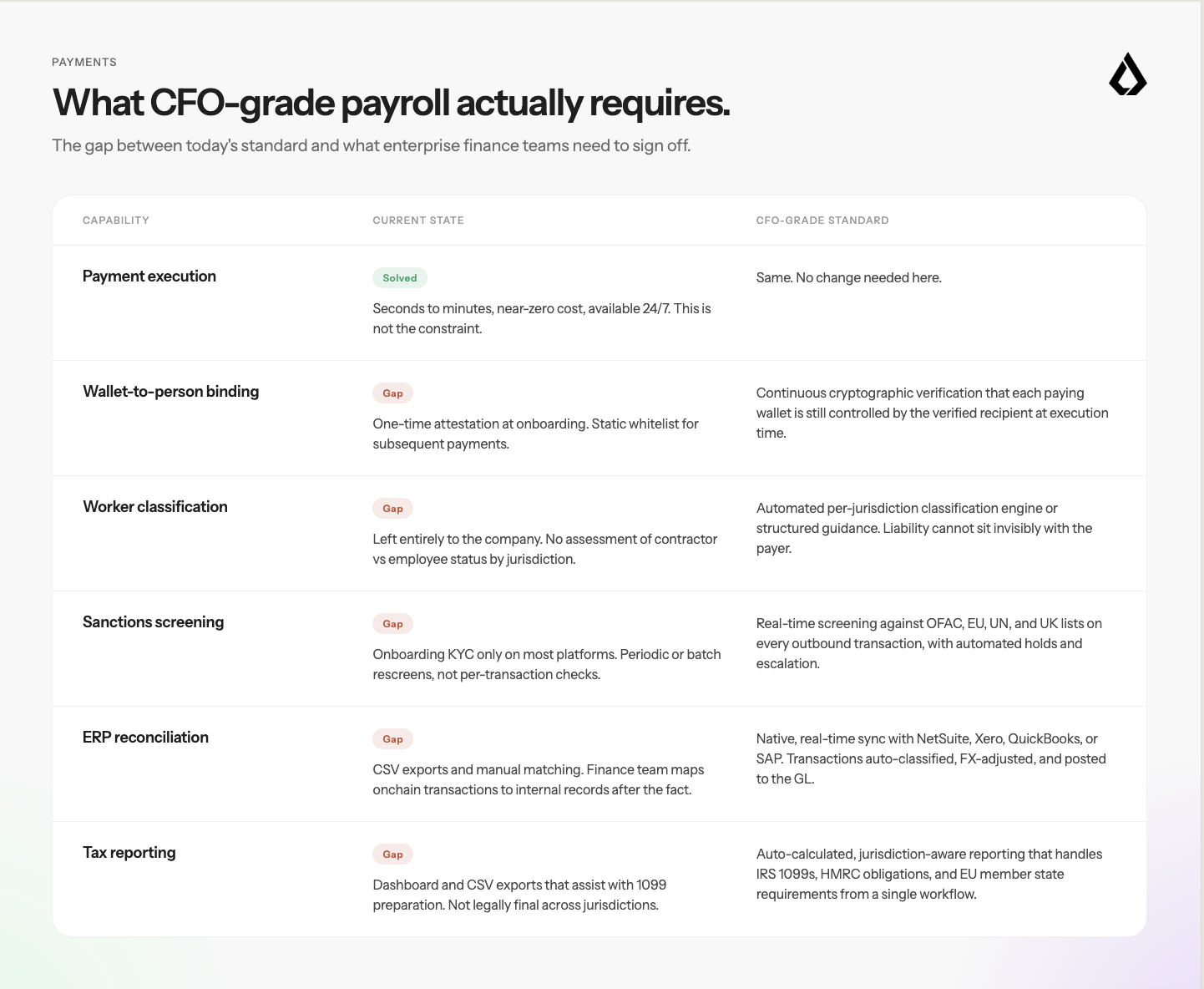
With stablecoin payroll, this chain breaks. A wallet address is a string of characters that anyone with the private key controls. It records addresses and amounts, not identities. Most platforms bind wallet to person once, at onboarding, through a one-time message signature or test transaction. After that, the platform trusts the whitelist.
The structural problem is that whitelists go stale. Keys get shared. Wallets get compromised. Finance officers with system access can insert phantom payouts that reference wallet addresses rather than named recipients, and those payouts blend into the transaction log until auditors cross-reference onchain activity with payroll records. Specialist compliance vendors are beginning to push continuous wallet risk monitoring and verifiable credential frameworks, but there is no mainstream payroll product today doing cryptographic proof-of-control on every pay cycle. Most of the industry is still relying on one-time binding and hoping the whitelist holds.
CFO-grade infrastructure needs more than hope. It needs ongoing proof that the wallet receiving each payment is still controlled by the intended recipient, with fallback recovery procedures for when it is not.
Classification does not care about the rail
Stablecoin payroll makes it trivially easy to pay someone anywhere. Whether it is legal to pay that person as a contractor, under the laws of their jurisdiction, is an entirely separate question, and one that no payments rail can answer.
Every country applies its own tests to distinguish employees from independent contractors. Brazil looks at subordination, habituality, and whether services are rendered personally to a single client. Germany and the broader EU assess organizational integration and economic dependency. Nigeria, India, and the Philippines each have their own frameworks, and each treats regular, full-time work patterns as indicators of employment regardless of how the worker is compensated or through what system the payment arrives.
The risk is not that stablecoins create new classification doctrine. It is that stablecoin payroll amplifies existing risk by making it easy to pay globally distributed workers who, in substance, work like employees. The GENIUS Act in the US and MiCA in Europe are not payroll regulations, but they are making stablecoin flows more visible to regulators and tax authorities, which means misclassification will be easier to detect and enforce, not harder.
Most stablecoin payroll platforms today handle classification by not handling it. They process the payment. The company is left to determine whether the arrangement meets the legal criteria for independent work in each jurisdiction where it operates. At ten contractors across three countries, that is manageable. At fifty contractors across twenty, it is a liability accumulating in plain sight.
Sanctions screening at onboarding is not sanctions compliance
Sanctions lists are not static. OFAC, EU sanctions regimes, and national watchlists are updated regularly, sometimes multiple times a week. A wallet address that was clean at onboarding can become associated with a sanctioned entity or jurisdiction at any point after that.
Enterprise-grade compliance infrastructure, the kind built by vendors like Fireblocks and Sumsub, offers real-time, per-transaction screening that covers OFAC, EU, UN, and proprietary risk lists, with behavioral scoring and automatic holds. That capability exists. The gap is that it is not universally embedded in payroll products. Many platforms in the stablecoin payroll space perform thorough KYC at onboarding and then rely on a static whitelist for subsequent payments, running periodic or batch rescreens rather than checking each outbound transaction at execution.
For companies subject to US, EU, or UK sanctions regimes, this is not a technical nicety. It is a legal exposure. The Sumsub Travel Rule compliance guide frames it directly: compliance must operate in real time, within transaction flows, not alongside them. A payment is only as compliant as its screening was current at the moment of execution.
Reconciliation at scale is still a manual job
Finance teams do not live on the blockchain. They live in NetSuite, Xero, QuickBooks, and SAP. Every stablecoin payroll transaction needs to map to a payroll record in the company's accounting system, generate correct journal entries in the reporting currency, handle FX conversion accounting when payees receive local currency, and produce documentation that survives audit review.
The tooling to do this well exists. Platforms like Cryptoworth and Optimus offer native ERP integrations, real-time GL sync, and automated matching that can reduce reconciliation time from dozens of hours per month to a few hours. But these tools are not yet standard inside stablecoin payroll products. The typical flow is still: run payroll through the platform, export a CSV of onchain transactions, manually match to internal records, calculate FX impact, and generate reports.
At ten contractors, this takes an afternoon. At two hundred, it is a full-time role. At a thousand, it is unsustainable. The reconciliation debt accumulates quietly until a month-end close or an audit makes it visible all at once. The Stripe overview of crypto treasury management notes this directly: without systematic reconciliation, organizations face compliance gaps that undermine their ability to defend tax positions or satisfy auditor inquiries.
Tax reporting has not caught up
Paying a contractor in USDC does not eliminate the payer's tax reporting obligations. In the US, the IRS treats stablecoins as property, not currency, which means payments in USDC must be reported at USD fair market value at the time of payment, and the payer must issue 1099s where thresholds are met. HMRC in the UK applies the same property treatment in GBP. EU member states follow their own rules, generally treating stablecoin payments as equivalent to monetary value at the time of settlement, but national guidance on cross-border contractor payments remains patchy.
The practical problem is that the payment moment, the settlement moment, and the off-ramp conversion moment may all occur at different times, creating potential FX discrepancies in what should be reported and when. For most stablecoin payroll platforms, tax reporting is assistive rather than complete. They provide dashboards and CSV exports that help with 1099 preparation. They do not deliver legally final, multi-jurisdiction tax filings out of the box.
That gap is manageable for early adopters with small contractor counts and finance teams willing to do the work. It becomes a structural problem as company size and jurisdictional complexity increase, and as regulators in the US and EU develop more explicit requirements for stablecoin-denominated compensation reporting.
Why this matters now
Stablecoin payroll is crossing an adoption threshold. Enterprise surveys put active stablecoin use for payments at nearly half of institutions polled. The GENIUS Act, signed in December 2025, is imposing bank-grade compliance requirements on stablecoin issuers and service providers, with strong KYC, Travel Rule, and sanctions control obligations that flow through to the platforms using their tokens. MiCA's stablecoin provisions became fully effective in January 2026.
This is not an environment where "move fast and figure out compliance later" works. The companies adopting stablecoin payroll in 2026 are mid-market and enterprise firms with real auditors, real compliance officers, and CFOs who need to sign off. They are not asking whether stablecoins can move money. They are asking which platform gives them continuous wallet verification, per-transaction sanctions screening, automated reconciliation, and multi-jurisdiction tax reporting, so their teams do not have to build it internally.
The companies that treat compliance and reconciliation as a core product, not as a roadmap item, will define the next era of global payroll. The payments layer is solved. The operations layer is where defensible businesses will be built.