
The case for stablecoins in cross-border B2B payments rests heavily on speed. Moving value from one wallet to another on major networks takes seconds to minutes, costs fractions of a percent, and runs around the clock. That is not marketing. It is measurable and it represents a genuine improvement over correspondent banking chains that can hold a payment for one to five business days while it moves through intermediaries in different time zones. Academic analysis of stablecoins in payments documents this clearly: stablecoin rails reliably compress the settlement portion of a payment from days to minutes and reduce rail-level fees to fractions of traditional wire costs.
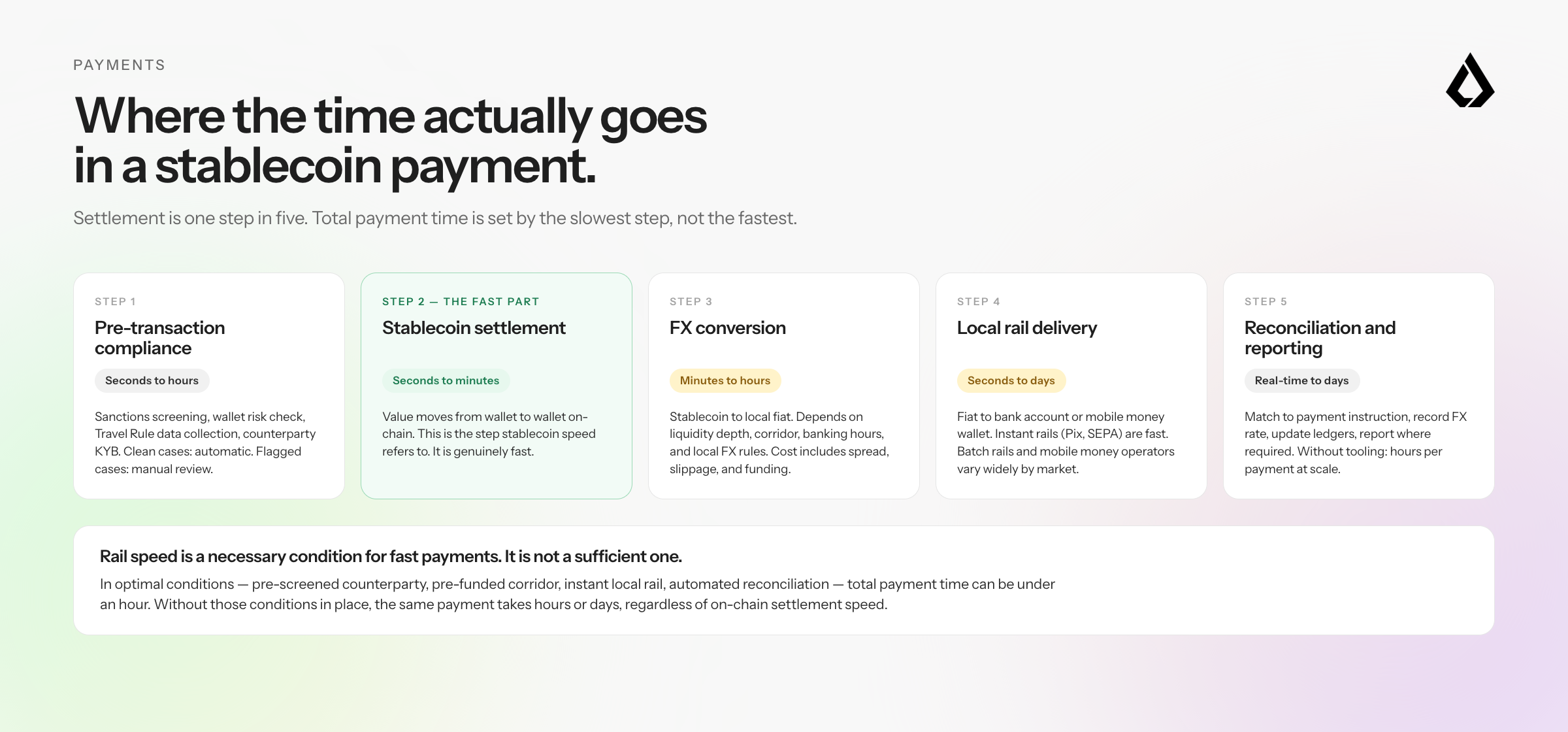
The problem is that settlement is one step in a payment, not the whole payment. A business does not send money and receive money. It initiates a payment, which first passes through compliance checks. The payment settles on the rail. The stablecoin has to be converted to local fiat. The fiat has to reach a bank account or mobile money wallet. The transaction has to be recorded, matched, and reported. Each of those steps runs on its own timeline, and none of them move at the speed of the blockchain.
The total time of a payment is not determined by its fastest step. It is determined by the slowest. Businesses that build on the assumption that stablecoin speed translates to payment speed discover this only once they are running real operations, and the discovery is usually expensive.
Before the Payment Leaves: Compliance
Before a B2B stablecoin payment can be initiated, it typically passes through sanctions screening, wallet address screening against risk databases, Travel Rule data collection and validation, and counterparty KYB verification. For a clean payment to a known counterparty with a pre-approved address, automated screening completes in seconds. For anything that triggers a flag — a partial name match on a sanctions list, a wallet address with historical exposure to a high-risk service, a counterparty whose data is incomplete — the payment waits for human review. Chainlink’s stablecoin compliance analysis captures the dynamic precisely: the rail can move funds far faster than human review cycles, so the compliance layer becomes the rate-limiting step for any payment that does not clear automatically.
For new counterparties, this problem compounds. A payment to a counterparty whose wallet has not been pre-screened, whose KYB data is not already on file, or whose Travel Rule information is not available in the right format will wait until that data is collected and verified. The stablecoin network is ready to settle in seconds. The payment will not be sent for hours. Sumsub’s analysis of Travel Rule compliance at scale frames this as a structural mismatch: stablecoins expose the limits of manual compliance processes because the rail moves faster than any human review cycle can.
After Settlement: FX Conversion
For cross-border payments that involve currency conversion — which is most B2B stablecoin payments into emerging markets — the FX conversion step runs after settlement and can be the longest and least predictable part of the flow. Conversion involves sourcing liquidity at the right price in the target currency, executing the trade through an OTC desk, exchange, or onchain mechanism, managing spread and timing risk, and ensuring both legs of the conversion settle correctly. Rain.xyz’s analysis of B2B stablecoin payment infrastructure documents this layer explicitly: even when the on-chain leg settles in minutes, FX conversion can add hours when liquidity is limited, compliance checks are triggered at the conversion step, or local banking windows are missed.
The cost components of FX conversion extend well beyond the headline spread. Funding costs for pre-funded local accounts, slippage in thin or volatile markets, and operational fees charged by liquidity providers and offramps all contribute to a total conversion cost that is harder to see than the rail fee but often larger. World Bank Remittance Prices Worldwide Q3 2025 shows that in corridors into Sub-Saharan Africa, total end-to-end costs including FX and last-mile delivery remain in the 7 to 8 percent range; the stablecoin rail saves meaningfully on the cross-border leg, but the surrounding cost layers absorb most of that saving.
The stablecoin compresses the middle of the payment. The FX conversion and local delivery steps are still governed by local liquidity, banking hours, and regulatory requirements that do not move at blockchain speed.
After FX: Local Rail Delivery
Once stablecoins have settled and been converted to local fiat, the funds still have to reach a bank account or mobile money wallet in the destination market. This step inherits all the constraints of domestic payment infrastructure. In markets with real-time payment systems — Brazil’s Pix, SEPA Instant in Europe — final delivery can complete in seconds around the clock. In markets where ACH-style batch rails dominate, funds may arrive the next business day or later depending on when the payment hit the cut-off window.
Mobile money adds a further layer of complexity. In Sub-Saharan Africa, mobile money is the practical last mile for hundreds of millions of people; the GSMA’s 2026 State of the Industry report documents more than 2.3 billion registered mobile money accounts globally and $2 trillion in transactions processed in 2025. Getting funds into those wallets requires direct integration with each mobile network operator, and each has its own API behaviour, transaction limits, KYC tier requirements, and downtime characteristics. A stablecoin payment that settled onchain in 30 seconds may wait hours for a mobile money credit if the local operator’s system is congested, the transaction exceeds a wallet tier limit, or the credit arrives outside processing hours. Large or unusual credits can also trigger bank-side manual review, adding delays that are entirely independent of the stablecoin leg.
After Delivery: Reconciliation
Once funds reach their destination, the payment is not finished from an operational perspective. It has to be matched against the original payment instruction, recorded in the accounting system with the correct FX rate and classification, and reported where required. For a business processing significant payment volumes, reconciliation is not a quick task. Research on crypto reconciliation for finance teams documents that without dedicated tooling, high-volume teams can spend roughly 40 hours per month on manual reconciliation of onchain and fiat flows — the equivalent of a full-time role consumed by matching records rather than managing the business. With specialised subledger infrastructure that number can drop to under five hours with near-perfect accuracy.
At the transaction level, the effort per payment can dwarf the milliseconds of onchain settlement. When exceptions occur — a partial failure, a delayed mobile money confirmation, a mismatched FX rate — reconciliation work multiplies. Businesses running high volumes without automated reconciliation are not running payment operations. They are running a reconciliation operation that also happens to process payments.
What the Total Timeline Actually Looks Like
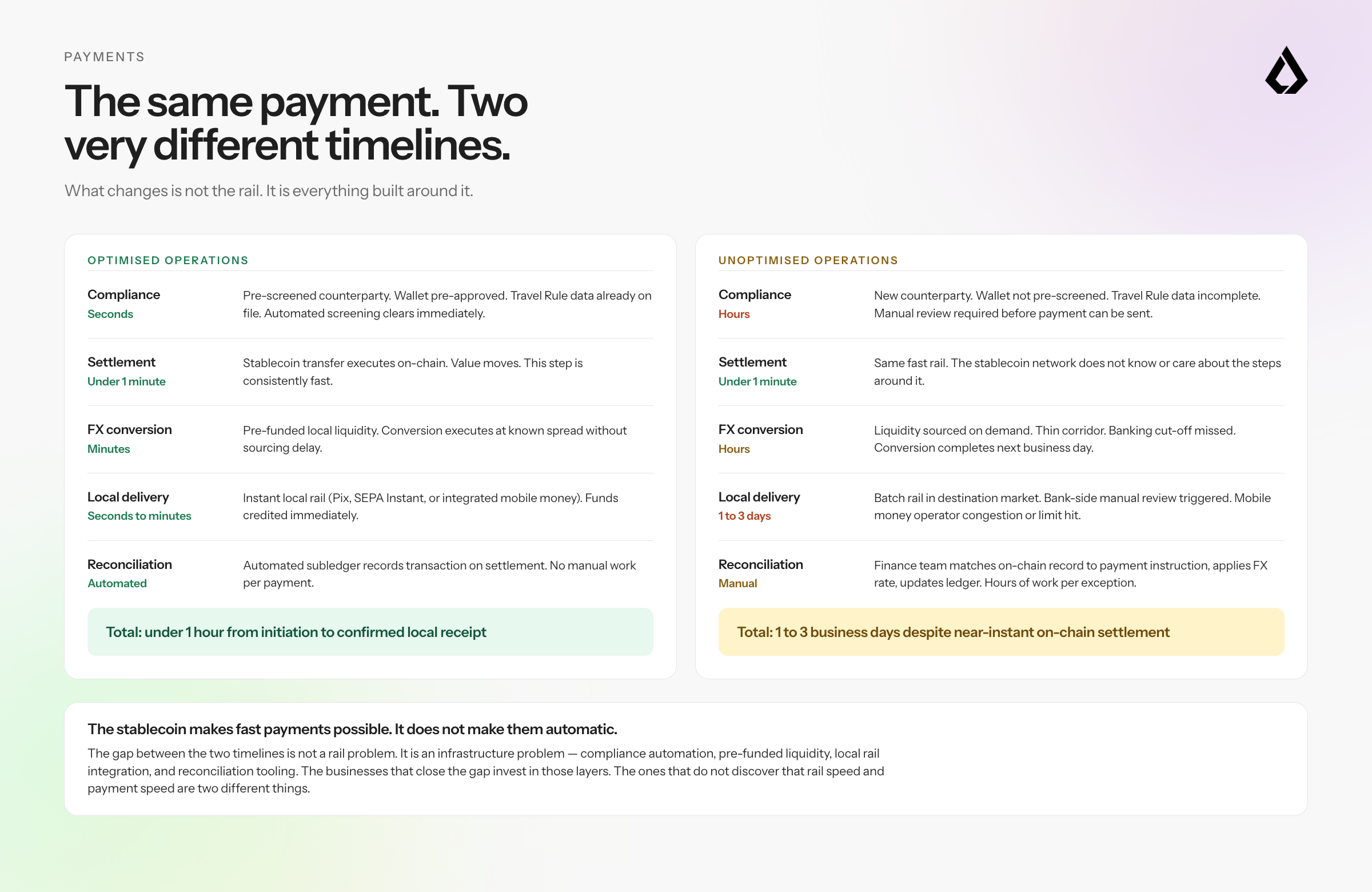
When all steps are included, the end-to-end timeline of a B2B stablecoin payment varies enormously depending on corridor, counterparty, and infrastructure. Fireblocks’ 2026 blueprint for stablecoin payment infrastructure describes the achievable benchmark for well-optimised operations: under an hour from initiation to usable local funds in optimal corridors with pre-screened counterparties, pre-funded local liquidity, instant local rails, and automated reconciliation. In corridors where any of those conditions do not hold, the same payment can take hours or days — despite on-chain settlement completing in under a minute.
The comparison to traditional wires is still favourable. A SWIFT transfer that takes one to five business days end-to-end is genuinely slower than a stablecoin payment that takes two hours. The improvement is real. What it is not is the near-instant payment experience that settlement speed alone implies. Rail speed is a necessary condition for fast payments. It is not a sufficient one.
Closing the Gap
The businesses that get closest to stablecoin-speed payments across the full payment cycle have made similar investments. Pre-screened counterparty lists and continuously monitored wallets mean most payments clear compliance automatically rather than waiting for manual review. Pre-funded local liquidity in key corridors eliminates the FX sourcing delay. Deep integrations with local instant payment systems and mobile money operators — maintained as production infrastructure, not point integrations — handle last-mile delivery reliably. Automated reconciliation pipelines record transactions as they settle and surface exceptions in real time rather than accumulating them for month-end.
What these businesses have built is not just a faster rail. It is a payment operation where every surrounding step has been engineered to match the speed of the underlying network. That is a significant infrastructure investment, and it is one that most businesses have not made because the components — compliance automation, liquidity management, local rail integration, reconciliation tooling — have historically existed as separate products from separate vendors with no unified layer connecting them.
The stablecoin makes the investment worth making. It does not make the investment unnecessary.