
The appeal of stablecoins for businesses operating across currencies is straightforward: hold your working capital in a dollar-pegged asset, and you sidestep the foreign exchange volatility that erodes value when you hold local currency. In markets where the naira, peso, or lira can move 15 to 35 percent in a year, that logic is not just reasonable, it is often the right operational decision.
But there is a version of this thinking that goes further, and it is where the analysis starts to break down. The assumption that holding USDC eliminates foreign exchange risk conflates two different things: eliminating the volatility of a specific currency, and eliminating foreign exchange exposure entirely. The first is real. The second is not. For any business that collects revenue in local currency, pays obligations in local currency, or prices its products for customers who think in local currency, foreign exchange exposure does not disappear when you add stablecoins to the stack. It moves. And in moving, it often becomes harder to track.
Where the Exposure Actually Lives
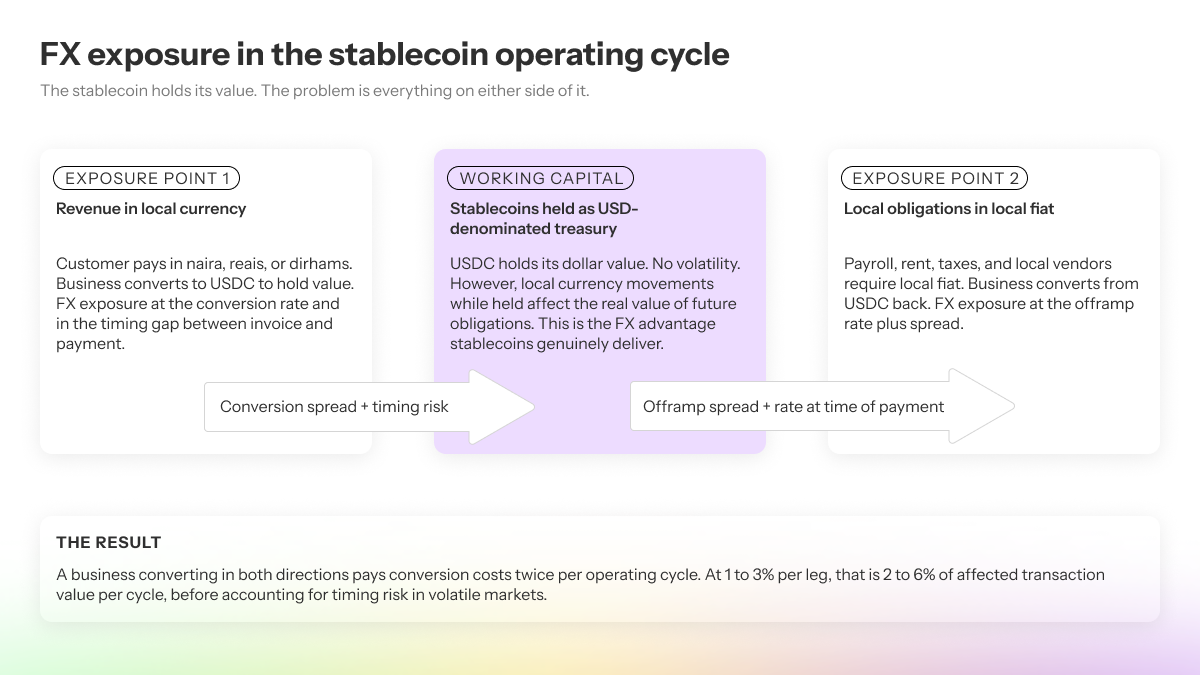
Foreign exchange risk for a stablecoin-using business concentrates at three specific points in the operating cycle, none of which go away simply because working capital is held in USDC between those points.
Revenue receipt and conversion. Many businesses in emerging markets invoice and collect in local currency — naira, reais, pesos, rupiah — because that is what their customers hold and spend. Converting that revenue into stablecoins means taking a foreign exchange rate at the moment of conversion. If the local currency has moved between the time the invoice was issued and the time payment was received and converted, value has been gained or lost. The timing gap between billing, collection, and conversion is a foreign exchange exposure window, and in volatile markets it can be material. According to FXC Intelligence’s analysis of stablecoin cross-border payments, 70 to 80 percent of the total cost in cross-border flows comes not from headline fees but from spread, routing, and timing decisions — the hidden costs that accumulate in the gaps between conversion events.
Local obligations and offramp. Payroll, rent, taxes, and local vendor payments need to be settled in local fiat. That means converting stablecoins back through an offramp or payment service provider at whatever rate and spread applies at the time of payment. The stablecoin is still worth one dollar. But one dollar buys a different amount of naira today than it did last month, and the offramp charges a spread on top of that. Every payment in local fiat is a conversion event, and every conversion event has a cost.
Pricing and settlement mismatch. Businesses that price in local currency but want to settle or hold in dollar-pegged stablecoins are exposed to the gap between the two. If a Nigerian business quotes a price in naira and the naira depreciates between quoting and collecting, the dollar value of that revenue has already shrunk before any conversion happens. Running a USD-denominated cost base against a local-currency revenue stream is a foreign exchange position, whether or not it is managed as one.
What the Numbers Look Like
The cost of conversion is often framed in comparison to traditional banking rails, and on that comparison stablecoins perform well. The World Bank’s Q1 2025 remittance data puts the global average cost of sending money internationally at 6.49 percent, with banks significantly more expensive than that in many corridors. Against that baseline, stablecoin routes that cost 2 to 4 percent in total onramp and offramp fees represent a genuine improvement.
But the comparison to traditional rails is not the same as the comparison to zero. A business making conversions in both directions — local currency into stablecoins on revenue receipt, stablecoins into local currency for local obligations — is paying conversion costs twice per operating cycle. Card-based onramps typically cost 2 to 5 percent. Bank transfer onramps run 0.5 to 2 percent. Mobile money corridors, common across Africa, sit at 1 to 3 percent. Even at the low end, a business converting in both directions is paying 1 to 4 percent of the transaction value each time, before accounting for timing risk.
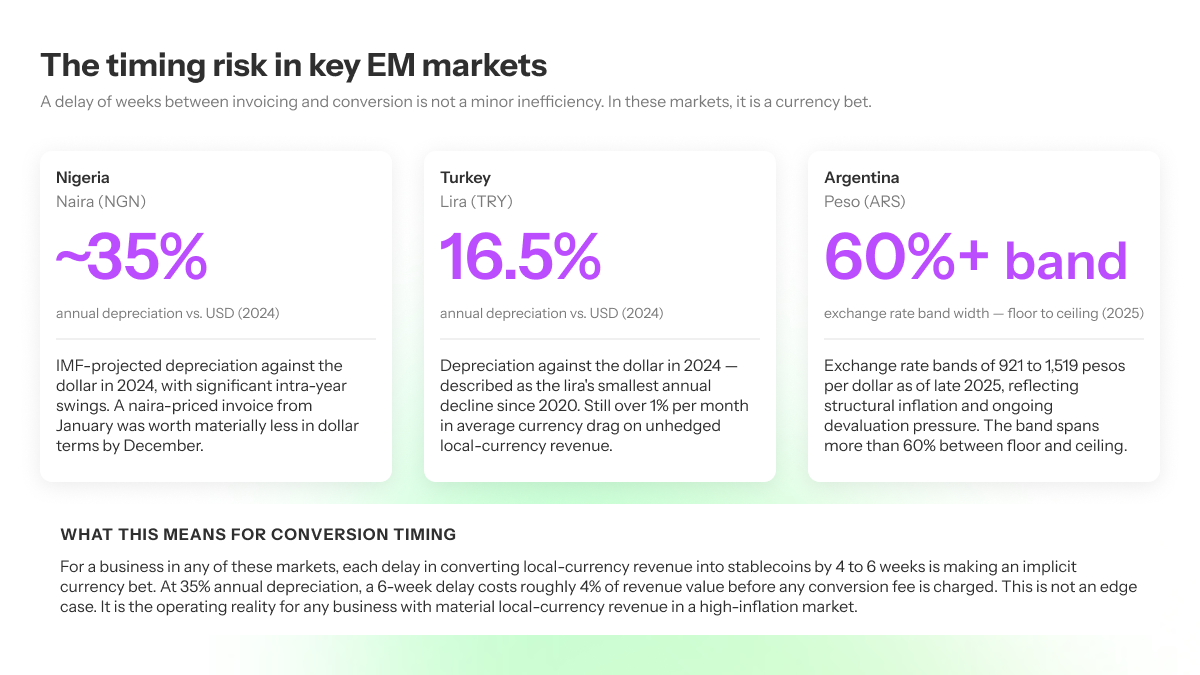
The timing risk is where the larger losses tend to hide. The naira depreciated roughly 35 percent in 2024 against the dollar, according to IMF projections, with material swings across the year. The Turkish lira declined 16.5 percent against the dollar in 2024, its smallest annual decline in years, but still significant. Argentina’s peso traded within exchange rate bands of 921 to 1,518 pesos per dollar by late 2025, reflecting ongoing inflation and devaluation pressure. In any of these markets, a business that delays conversion by even a few weeks is making an implicit currency bet, whether it intends to or not.
How Businesses Are Managing It — and Where That Breaks
The standard approaches to managing this are well-established and each comes with meaningful limitations at scale.
Natural hedging. The cleanest solution is to match revenue and costs in the same currency, earning and spending in dollar stablecoins wherever possible, so that conversions are minimised. For businesses whose customers and suppliers all operate in the same currency ecosystem, this works well. For businesses selling to local customers and buying from international suppliers, or vice versa, a complete natural hedge is often not achievable.
USD-denominated pricing. Some businesses solve the problem by quoting in dollars or dollar-pegged stablecoins, shifting the foreign exchange burden to the customer. Bitso’s record $82 billion in stablecoin transactions across Latin America in 2025 reflects in part this shift toward dollar-denominated commercial relationships. But pricing in dollars limits the addressable market in economies where customers budget and think in local currency, and it does not help with local-currency obligations on the cost side.
Conversion timing and laddering. Treasury teams that are managing this carefully stagger conversions — weekly or monthly sweeps into stablecoins rather than converting immediately on receipt — trying to reduce the number of conversion events and smooth out timing risk. Fireblocks’ treasury guidance describes this approach as part of active treasury management for businesses holding crypto alongside fiat. The limitation is that it requires active management, informed judgment about currency direction, and time, all of which are scarce resources for a lean finance team.
Multi-currency accounts. Holding balances in multiple currencies via platforms like Airwallex or Wise — which publish real-transaction FX rate comparisons showing 0.3 to 0.5 percent spreads on major pairs vs 2 to 4 percent at traditional banks — allows businesses to defer conversion until the rate is more favourable or the need is more immediate. It reduces conversion frequency but does not eliminate the exposure.
Where all of these approaches break is at scale and in combination. As transaction volumes grow, manual foreign exchange management across multiple rails, multiple currencies, and multiple providers becomes time-consuming and error-prone. Cryptio’s documentation of reconciliation gaps captures what this looks like in practice: operators must track which payments were charged in what currency, when they were converted, and which rate applied — across systems that do not share data. Without integrated tooling, the risk of double-exposure is real: paying spreads on the onramp and again on the offramp, without a clear picture of the cumulative cost across the cycle.
Where Stablecoins Genuinely Help
It is worth being clear about where the stablecoin FX advantage is real, because it is real in specific contexts.
For businesses making cross-border B2B payments on traditional correspondent banking rails, stablecoins offer a measurable cost reduction. Replacing a 6 to 10 percent bank or remittance fee with a 2 to 4 percent stablecoin conversion cost is a genuine improvement that compounds across transaction volume. FXC Intelligence estimates the total addressable market for stablecoin cross-border payments at $16.5 trillion, concentrated precisely in the corridors where traditional rails are slowest and most expensive.
For treasury preservation in high-inflation markets, converting local currency holdings into stablecoins is a rational and often necessary decision. Yellow Card’s analysis of Africa’s stablecoin adoption documents businesses converting local currency into USDC or USDT specifically to preserve USD value against local inflation. In a market where the local currency is losing 15 to 35 percent of its value annually, paying 1 to 3 percent to convert into a stable asset is clearly worth it. The conversion cost is not the problem. The problem is pretending it does not exist.
The distinction matters for how businesses budget and plan. A company that treats its stablecoin treasury as FX-free is underestimating its cost of capital and misattributing margin erosion. The foreign exchange cost does not disappear in the accounting or in the bank balance. It shows up as a slightly smaller number at each conversion point, accumulated across the operating cycle, without a clear owner or a line item in the P&L.
What Budgeting for It Actually Looks Like
The businesses that manage this well treat foreign exchange cost as an explicit operational expense rather than a residual. That means a few specific practices that are straightforward to implement but rarely applied consistently.
Track conversion events, not just balances. Every time local currency is converted to stablecoins and every time stablecoins are converted to local fiat, the rate, the spread, and the timing should be recorded. The cumulative cost of those events across a quarter is the actual foreign exchange burden on the business, and it is almost always higher than the number in people’s heads.
Budget for conversion costs explicitly. If a business is operating in a corridor where onramp and offramp costs run 1 to 3 percent, that needs to appear in the unit economics alongside payment processing fees and compliance costs. It is not a treasury rounding error. It is a cost of operating in that market.
Build conversion timing into treasury policy. The decision of when to convert is not just an operational convenience, it is a foreign exchange decision. A business that converts on receipt versus one that converts weekly versus one that converts monthly is making three different currency bets. Fireblocks’ framing of treasury management is useful here: capital in motion is capital at work, but capital moving between currencies without a policy is capital leaking value without a record.
Stablecoins have made cross-border business materially more efficient for a large number of operators. The FX advantage is real and measurable. What is also real and measurable — and far less discussed — is that the conversion cost, the timing risk, and the pricing mismatch do not vanish when USDC enters the stack. They move to the edges of the operating cycle, where they are harder to see and easier to ignore until the margin numbers stop adding up.