
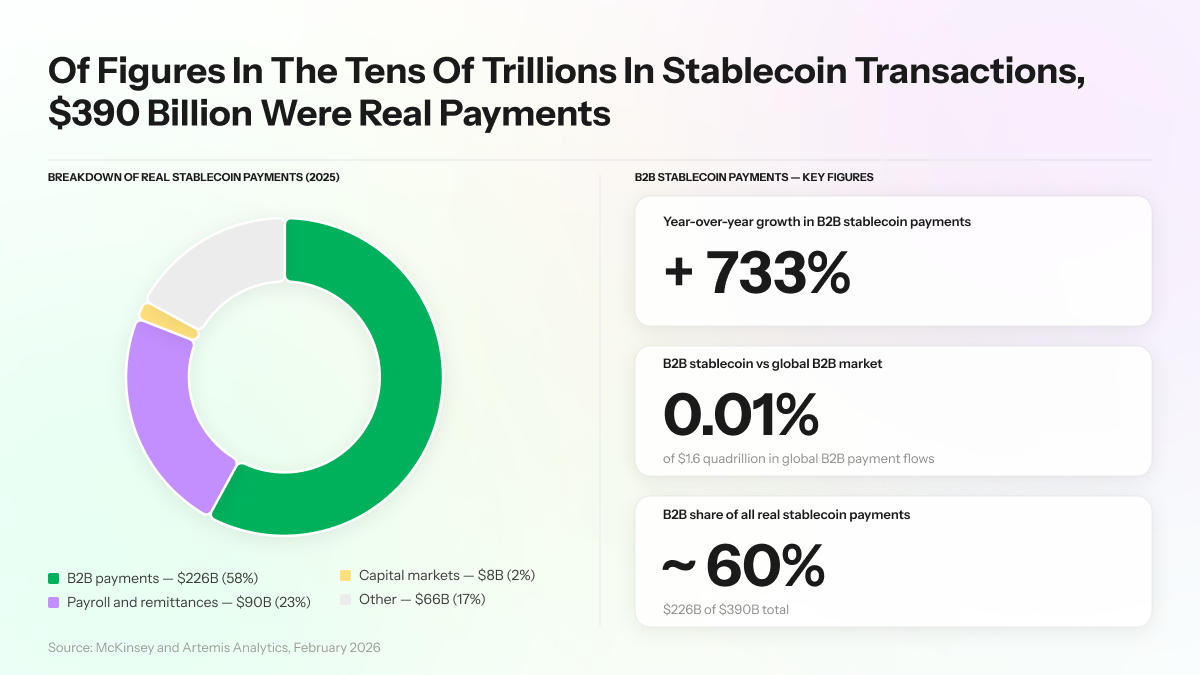
There is a number that gets cited constantly in conversations about stablecoins and business payments. You have probably seen it: some version of “trillions in stablecoin transactions,” often used to imply that business adoption is already at massive scale. A joint study by McKinsey and Artemis Analytics published in February 2026 does something useful: it strips out the noise. Trading flows, internal fund movements, automated protocol activity — gone. What remains is $390 billion in actual stablecoin payments for 2025, more than double 2024 levels. Of that, B2B transactions account for $226 billion, nearly 60 percent of the total, growing 733 percent year over year.
That is real traction. Businesses are actively choosing stablecoin rails for cross-border supplier payments, payroll, and settlements because the alternative — correspondent banking, with its multi-day clearing windows and percentage-point fee drag — is genuinely worse. The adoption is happening. But the headline figure is also only part of the story. For a company actually running B2B payments on stablecoin rails today, the experience on the ground is more complicated than the growth numbers suggest.
What the Data Actually Shows
The McKinsey-Artemis methodology is worth understanding because it changes how you read stablecoin payment statistics. Most figures cited in vendor content and investor commentary count total onchain stablecoin volume, which in 2025 reached figures in the tens of trillions of dollars. The vast majority of that is not payments. It is trading, custodial shuffling, and automated contract activity. The actual payment layer is $390 billion, about 1 percent of the headline number.
Within genuine stablecoin payments, the breakdown is: $226 billion in B2B transactions, $90 billion in global payroll and remittances, and $8 billion in capital markets settlement. B2B is the dominant use case by a wide margin, and its 733 percent year-over-year growth means it is pulling further ahead. For context, that $226 billion still represents about 0.01 percent of the $1.6 quadrillion global B2B payment market. The infrastructure is early. The growth curve is steep.
The geographic concentration in the data is also notable. Asia accounts for approximately $245 billion of the $390 billion total, driven by payments originating from Singapore, Hong Kong, and Japan. North America accounts for $95 billion, Europe $50 billion. Latin America and Africa together account for a small fraction of the tracked volume, but the Chainalysis 2025 Geography of Crypto Report notes that stablecoins are now the primary operational instrument for businesses in Sub-Saharan Africa and Latin America, used for payments, payroll, and trade because of practical necessity. Much of this activity runs through smaller exchanges and informal corridors that fall below the tracking threshold of institutional analytics.
What Actually Breaks
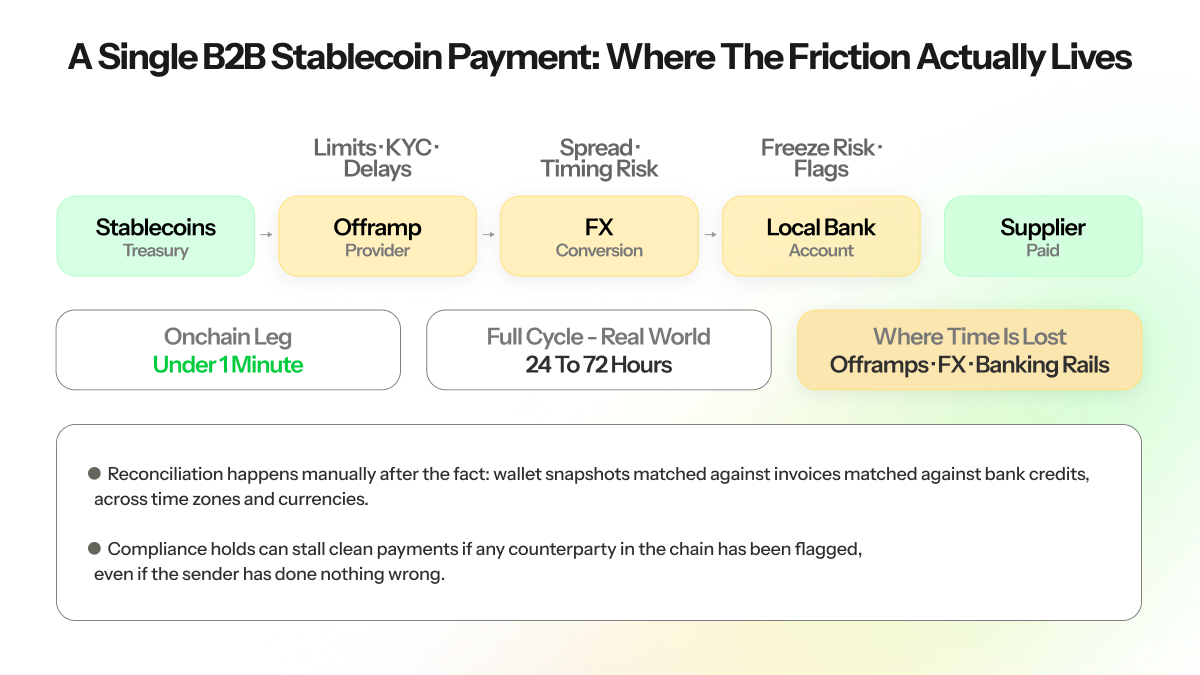
Operators running B2B stablecoin payments will tell you the same thing: the onchain leg works. The value transfer itself is fast and cheap. What breaks is everything around it.
Most suppliers and contractors, even those in crypto-adjacent industries, still need local fiat. That means an offramp. And offramp infrastructure varies enormously by corridor. In Singapore or Hong Kong, there are regulated, high-volume providers with predictable settlement timelines. In Nigeria, Kenya, or Indonesia, the picture is more fragmented: a smaller set of providers, lower daily limits, more documentation requirements, less predictable clearing. A payment that settles onchain in under a minute may take 24 to 72 hours to reach a vendor’s local bank account, depending on which corridor and which provider is involved. The stablecoin leg is solved. The last mile is not.
The compliance layer adds further complexity. Stablecoin issuers can freeze tokens associated with addresses flagged for compliance concerns, including legitimate business addresses that have inadvertently received funds from a flagged counterparty. Payments stall not because of anything the sender did wrong, but because of a flag two steps back in the chain. Resolving these holds requires manual intervention and documentation that most B2B payment workflows were never built to handle.
Then there is reconciliation. Most companies running B2B stablecoin payments have no automated way to match onchain transaction records against invoices and bank credits simultaneously. Finance teams are working from wallet snapshots, exchange statements, and bank records that were never designed to be reconciled against each other. Month-end becomes a manual exercise across time zones, currencies, and sometimes multiple stablecoin standards. The FXC Intelligence analysis of stablecoins in cross-border payments identifies this reconciliation gap as one of the primary operational friction points holding back broader B2B adoption, alongside offramp fragmentation.
Volume Is Running Ahead of Infrastructure
The 733 percent growth in B2B stablecoin payments reflects a genuine shift in how businesses think about cross-border transactions. Operators choosing stablecoin rails are doing so because the cost and speed advantages over legacy banking are real and measurable. But high volume does not automatically mean smooth operations.
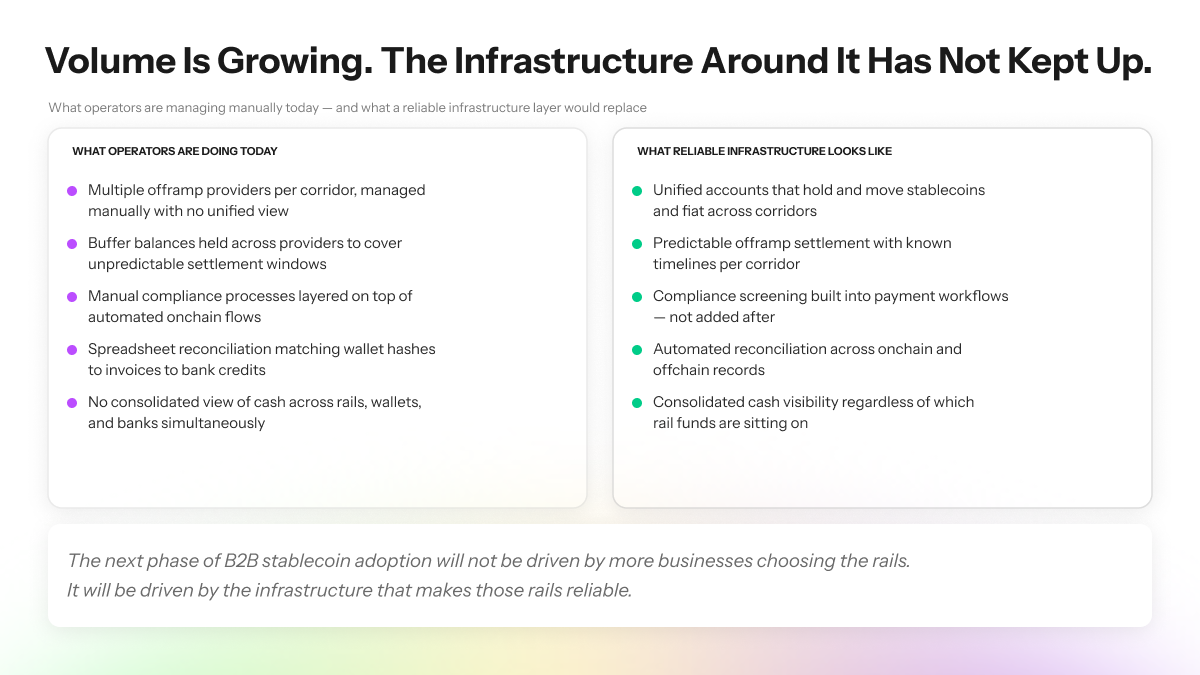
The businesses running the highest volumes of B2B stablecoin payments are often the ones who have invested the most in building around the gaps. Multiple offramp relationships per corridor. Buffer balances held across providers to manage unpredictable settlement windows. Manual compliance processes layered on top of automated onchain flows. Custom reconciliation spreadsheets maintained by finance teams who are, in effect, doing systems integration work. That is not a description of mature infrastructure. It is a description of a market in transition, where adoption has outpaced the tooling that would make adoption reliable at scale.
McKinsey’s framing is precise on this point. The $390 billion figure, they write, “establishes a clearer baseline for assessing where the market stands and what will be required for stablecoins to scale” rather than confirming that scale has been reached. The potential is not in question. The gap between where the market is and where it needs to be is in the infrastructure layer: unified accounts, reliable offramp settlement, compliance workflows built for multi-rail operations, and reporting that gives finance teams visibility across their entire cash position regardless of which rail it is sitting on.
The Question Has Shifted
For most businesses with meaningful cross-border payment flows, the question is no longer whether to use stablecoins. The cost and speed case is too compelling, and the data shows adoption is already underway at significant scale. The question is whether the infrastructure exists to do it without building a custom operations function from scratch.
Right now, for most operators, the honest answer is that it does not fully exist yet. The onchain settlement layer is solved. The account management, offramp reliability, compliance tooling, and reporting layer that sits around it is still fragmented, still largely manual, and still the primary constraint on what B2B stablecoin payments can actually do for a growing business.
The next phase of B2B stablecoin adoption will not be driven by more businesses choosing the rails. It will be driven by the infrastructure that makes those rails reliable.