The case for stablecoins in cross-border payments is well-established and, at the wholesale level, largely proven. Moving value from one country to another using USDC or USDT is faster than a correspondent banking chain, cheaper than most traditional wire transfers, and available around the clock. For the middle leg of a cross-border payment — the part that crosses borders — stablecoins represent a genuine infrastructure improvement.
The part that has not been solved is the last mile. Getting a settled stablecoin balance converted into local fiat, pushed to the right bank account or mobile money wallet, in compliance with local regulatory requirements, reliably, at scale; that is where most of the friction, cost, and failure in cross-border crypto payments actually concentrates. The rails improve the distance between countries. The last mile is the distance between the stablecoin and the person who needs the money, and it remains the hardest part of the stack to build.
What the Last Mile Actually Is
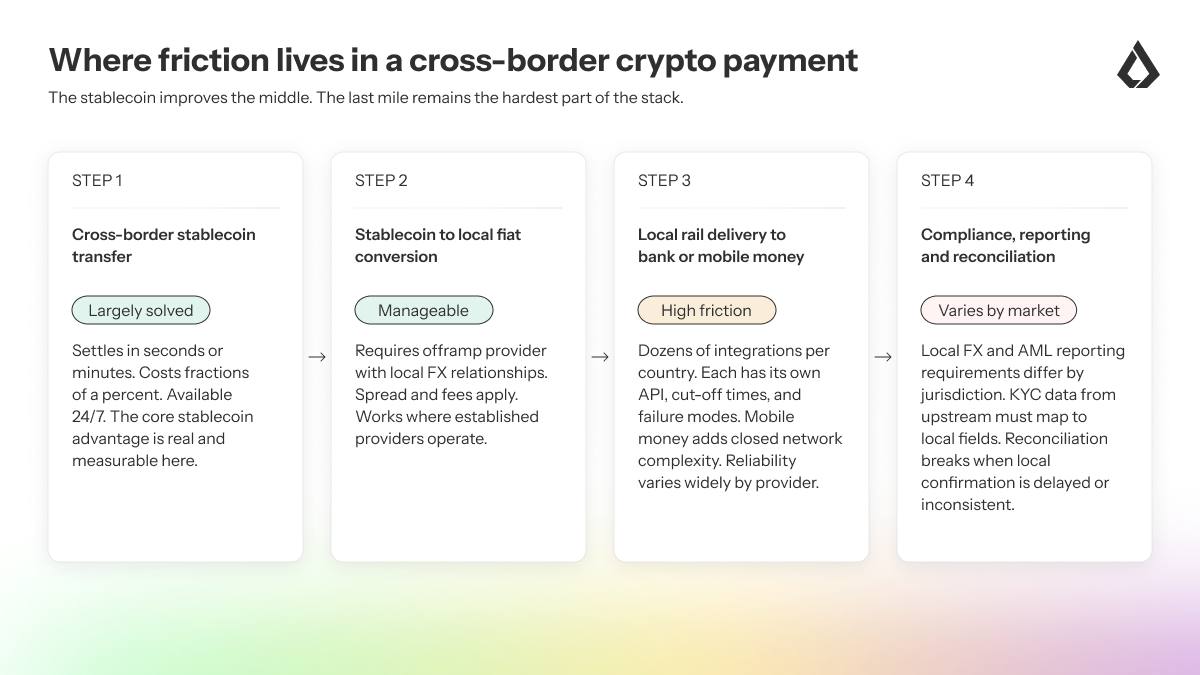
The last mile in cross-border crypto payments has four steps, and the first three are largely solved. A stablecoin transfer arrives at the provider’s wallet following cross-border settlement — that step is fast and cheap. The provider needs to convert those stablecoins into local fiat, typically through local foreign exchange partners or internal inventory — that step has costs and spread but is operationally manageable in most corridors. The fiat then needs to be pushed into local rails: a real-time gross settlement system, an automated clearing house, an instant payment network, or a mobile money platform — that step is where reliability problems begin. Then the payment has to be reconciled, reported, and in many jurisdictions treated as a regulated cross-border or foreign exchange inflow — that step adds compliance overhead that varies significantly by market.
The friction does not accumulate evenly across these steps. Conversion and liquidity are manageable where offramp providers have established relationships with local banks and foreign exchange partners. Local payout rail integration is where reliability issues emerge: each country has multiple banks, multiple mobile money operators, different technical APIs, different cut-off times, and different error handling. A provider serving ten markets is maintaining and monitoring dozens of individual integrations, each of which can fail independently. Compliance and data requirements add a layer on top: the know-your-customer and know-your-business data collected upstream in the payment chain has to be translated into local reporting fields, thresholds, and documentation requirements that differ by jurisdiction. And reconciliation — matching stablecoin settlement records against local disbursement confirmations — is technically straightforward in theory and operationally demanding in practice, particularly when a local payout confirmation is delayed or arrives in an incompatible format.
The stablecoin solves the distance. The last mile solves the delivery. These are different problems requiring different infrastructure.
The Offramp Fragmentation Problem
The last mile depends on local offramp providers — the companies that convert stablecoins into local fiat and push to local banking and mobile money rails. In most emerging markets, that landscape is fragmented, variable in quality, and subject to disruption.
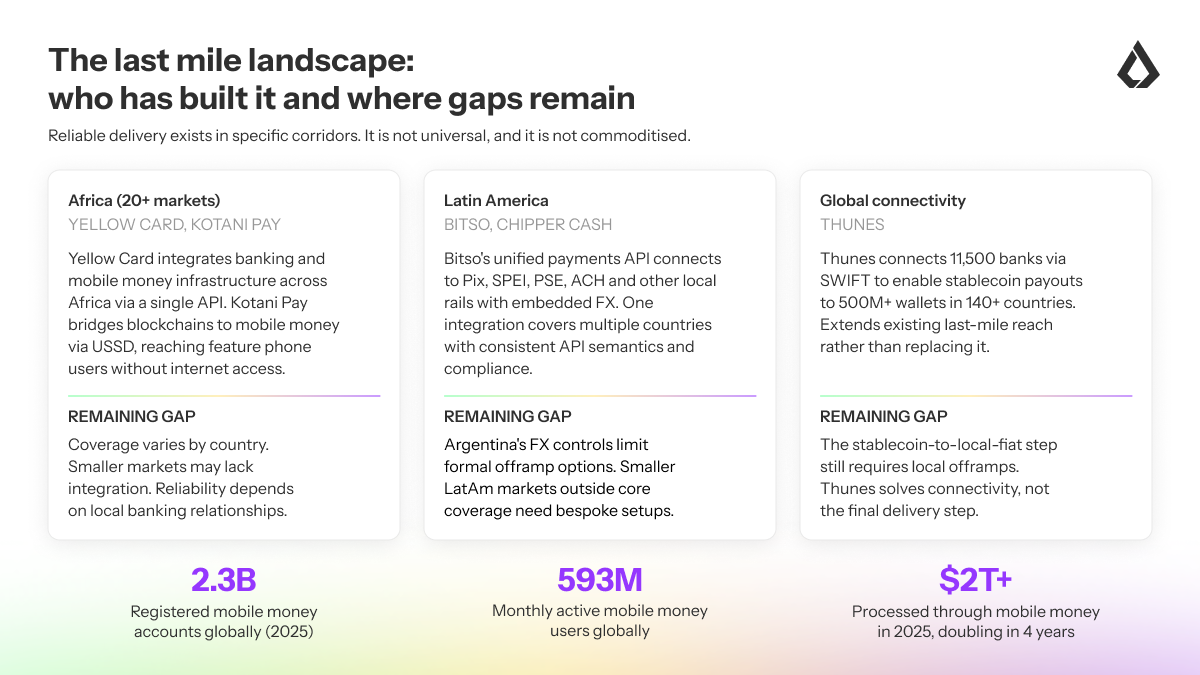
In Africa, Yellow Card has built a pan-African stablecoin rail that integrates banking and mobile money infrastructure across more than twenty markets, positioning itself as the offramp for global platforms including Coinbase, Block, and PayPal. Kotani Pay has built a complementary approach: a blockchain-to-mobile-money API for East and West African markets, using USSD rather than internet connectivity so that even feature phone users can receive stablecoin-backed payouts without a smartphone or bank account. These are meaningful pieces of infrastructure. They are also not universal — coverage gaps remain across specific countries, specific banks, and specific mobile money operators.
In Latin America, Bitso’s unified payments architecture exposes a single API for collections and payouts across the region’s major local rails — Brazil’s Pix, Mexico’s SPEI, ACH, and others — with embedded foreign exchange and stablecoin settlement underneath. That architecture works because Bitso has invested in the hard part: building and maintaining the local rail integrations, the foreign exchange relationships, and the compliance infrastructure in each market it operates. Building a similar capability from scratch requires years, not months.
Beyond the leading providers, a long tail of smaller offramp operators serves specific corridors, often with significant variation in uptime, liquidity depth, compliance capacity, and the terms on which they operate. When a smaller offramp has an outage — during a period of regulatory uncertainty, a liquidity crunch, or a change in its banking relationships — payouts queue, reconciliation backlogs grow, and operators have to route manually to secondary providers with different formats, different know-your-customer standards, and different fees. The risk is not theoretical. It is the operational reality of depending on infrastructure whose reliability is not standardised across providers.
The cost data makes the last mile’s contribution to total payment cost visible. The World Bank’s Q1 2025 remittance data puts the global average cost of sending a remittance at 6.49 percent. Into Sub-Saharan Africa specifically, costs run higher — around 8 percent on average as of early 2025. The stablecoin transfer itself may cost well under one percent. By the time foreign exchange conversion, local payout fees, mobile money charges, and compliance overhead are included, end-to-end costs in many African corridors climb back toward that 7 to 8 percent range. The savings from the stablecoin rail are real. They are being substantially absorbed by the last mile.
Mobile Money and the Last Mile
For hundreds of millions of people across Africa and parts of Asia, mobile money is not one channel among many. It is the primary financial account. The GSMA’s 2026 State of the Industry report documents 2.3 billion registered mobile money accounts globally and 593 million monthly active users as of 2025, with more than $2 trillion processed through mobile money wallets — doubling in value in just four years. The majority of active accounts are in Sub-Saharan Africa, where mobile money is often the only practical financial account available to a large share of the population.
For a business making cross-border stablecoin payments to recipients in these markets, reaching the recipient often means reaching their mobile money wallet, not their bank account. That creates a specific set of technical and regulatory challenges that sit on top of the offramp fragmentation problem.
Mobile money networks are closed systems. M-Pesa, MTN MoMo, Airtel Money, OPay, and Wave each have their own integration models, their own technical APIs, their own compliance rules, and their own operational characteristics. A provider that wants to deliver to mobile money wallets across five African countries is managing fifteen or twenty separate integrations, each of which requires a direct commercial relationship with the mobile network operator, ongoing technical maintenance, and real-time monitoring. When M-Pesa has downtime in Kenya, that affects every payment in that corridor until the service recovers. The provider’s stablecoin settlement may have completed successfully; what is pending is the final delivery step that the recipient is waiting for.
The regulatory layer adds further complexity. Mobile money transactions above defined thresholds require know-your-customer verification at the wallet level. Cross-border mobile money flows are treated as foreign exchange inflows in many jurisdictions and trigger reporting requirements. In some markets, the regulatory perimeter for stablecoin-to-mobile-money delivery is still being defined, creating uncertainty about what compliance documentation is required and which entity is responsible for it. Kotani Pay’s approach of integrating directly with mobile money operators through USSD — allowing payouts without internet connectivity or a bank account — demonstrates that creative infrastructure can reach populations that would otherwise be excluded, but Chipper Cash’s December 2025 partnership with Stable to build stablecoin payment rails across Africa illustrates that even established players are still investing in solving the last mile, not treating it as done.
What Reliable Last Mile Infrastructure Requires
The businesses that have made stablecoin-enabled cross-border payments work reliably at scale share a consistent set of characteristics that distinguish them from providers that work at small volumes but break under enterprise demand.
Single integration, many rails. The operational overhead of maintaining dozens of individual integrations is the primary reason last mile infrastructure is expensive to build and hard to replicate. Providers that abstract that complexity behind a single API — presenting one integration point that resolves to multiple local rails internally — create significant operational leverage for their customers. Thunes’ expansion to enable stablecoin payouts across 11,500 banks via SWIFT connectivity, connecting over 500 million stablecoin wallets across 140 countries, is the same principle applied at global scale: one connection point that resolves to a wide network underneath.
Deep local licensing and relationships. Technical integration is necessary but not sufficient. Reliable last mile delivery requires commercial relationships with local banks and mobile money operators, regulatory approvals in each market, and compliance programmes that satisfy local anti-money-laundering and foreign exchange requirements. These take years and significant capital to build. They cannot be replicated quickly by a new entrant, which is why the reliable last mile providers in most markets are the ones that invested in the regulatory infrastructure before the volumes arrived.
Enterprise-grade operations. The difference between a last mile solution that works at small volumes and one that works for enterprise flows is operational, not just technical. It requires multiple bank partners per rail for redundancy, live failover between payout corridors when one fails, real-time monitoring of payout status across every integration, and contractual service level agreements that give customers predictability. Manual processes that work for a few hundred transactions a day break at tens of thousands. The reconciliation layer — the internal ledger that tracks each payment from stablecoin receipt through foreign exchange conversion to local credit confirmation — has to be automated and auditable to operate at scale.
Why This Matters for Operators
For a business making cross-border stablecoin payments, the last mile question is not abstract. It directly affects which corridors you can serve reliably, what your actual end-to-end costs are, and what your customers experience when a payment does not arrive on time.
The practical implication is that corridor selection is not just a commercial decision about where there is demand. It is an infrastructure decision about where reliable last mile delivery exists. A corridor where the stablecoin settlement is fast and cheap but the local offramp is fragmented, limited in capacity, or regulatory uncertain is a corridor where the payment experience is unpredictable. The stablecoin did its job. The last mile did not.
For businesses building payments products rather than using them, the last mile question is more fundamental. The infrastructure decisions about which local rails to integrate, which offramp partners to rely on, how to handle mobile money delivery, and how to manage compliance at the disbursement step are product decisions that determine which markets you can serve and at what quality. The providers that have solved this — Yellow Card in Africa, Bitso in Latin America, Thunes globally — have solved it through years of investment in exactly these decisions. The stablecoin rail is a commodity. The last mile infrastructure is not.