
What most businesses do not plan for is what happens next. The entity structure gets built for regulatory, tax, and fundraising reasons. The operational question — how money actually moves between these entities, how those flows get recorded, and what compliance requirements apply to transfers between related parties — is usually deferred. It surfaces later, under pressure, when a treasury sweep is stuck, when month-end reconciliation spans four ledgers in three currencies, or when an auditor asks for documentation on intercompany flows that were never formalised. The entities are in place. The infrastructure to run them as a group is not.
This is one of the clearest cases in crypto-native business operations where the problem is not the technology and not the regulatory environment. It is the absence of financial infrastructure designed for how these businesses actually work.
How Businesses End Up Here
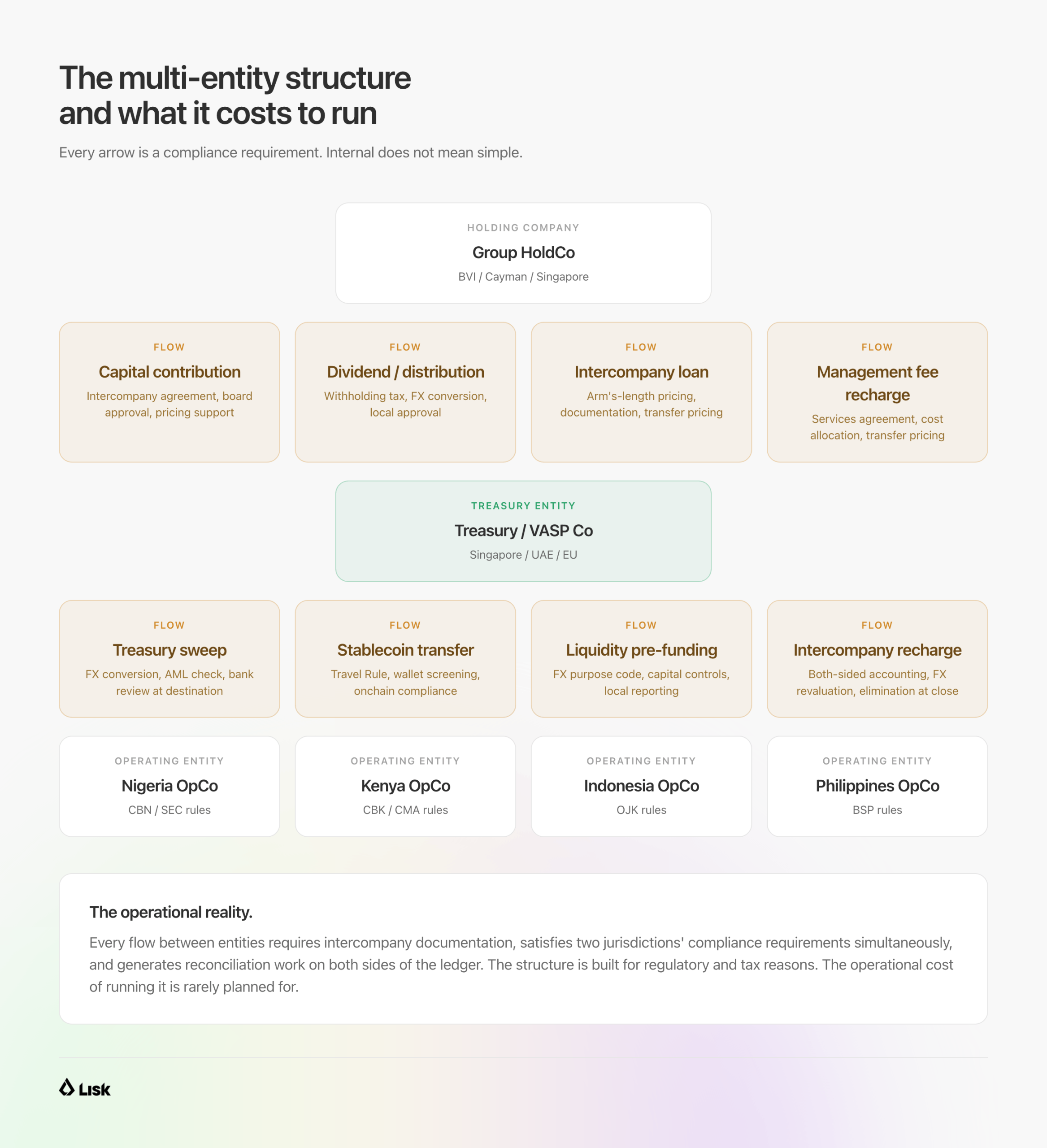
The drivers of multi-entity structure in crypto-native businesses are well understood individually. VASP licensing in specific jurisdictions often requires a locally incorporated entity. Local market access — bank accounts, payroll, contracts with local partners — typically requires a local subsidiary. Institutional investors expect a holding company structure in a recognised jurisdiction. Stablecoin treasury or custody functions are frequently isolated into a separate entity to limit liability and simplify regulatory treatment. Entity design guidance for crypto businesses describes this as the standard structure for any business operating stablecoin payments at scale: holding company for ownership, treasury entity for liquidity and settlement, operating entities for local execution.
What makes the resulting structure operationally demanding is not the number of entities, it is the number of money flows between them. Every intercompany loan, treasury sweep, management fee recharge, and capital contribution requires the same compliance, documentation, and accounting treatment as an external payment, and in some respects more, because the arm's-length requirement means the terms of each internal flow have to be defensible to tax authorities in both jurisdictions involved.
The Treasury Sweep Problem
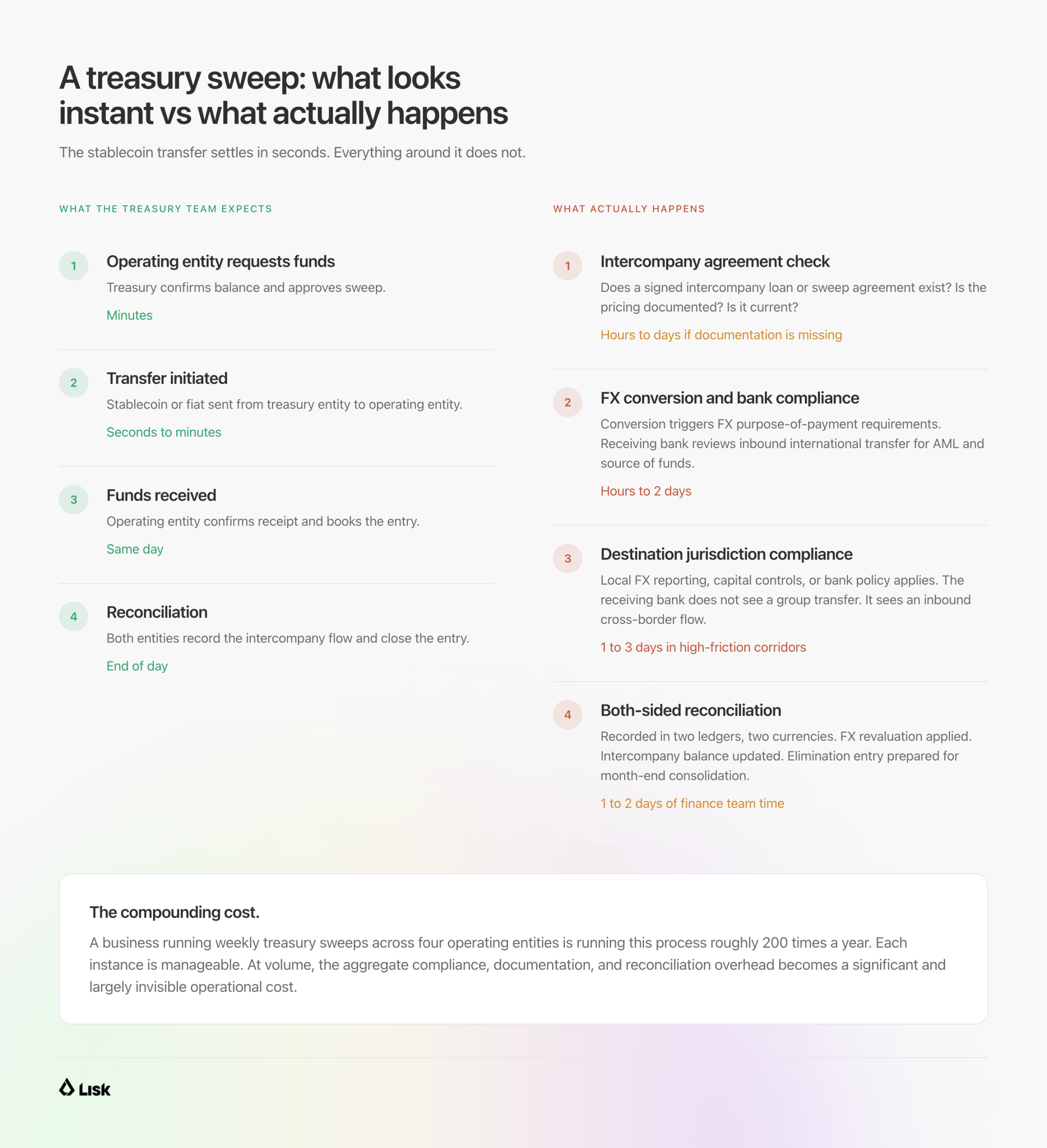
For businesses that centralise liquidity — holding working capital in a parent or treasury entity and pushing funds to operating entities as needed — the treasury sweep is the most frequent intercompany flow and the one that creates the most operational friction. In principle, a sweep from treasury to operating entity is a routine internal transfer. In practice it involves checking the intercompany balance, confirming the bank status and FX position of the receiving entity, executing the transfer across banking or onchain rails, handling any currency conversion, and ensuring both entities record the movement against the correct intercompany account. Treasury management tooling for stablecoin businesses describes this workflow explicitly; the steps that look instantaneous from the outside accumulate delays at each handoff.
The friction concentrates when the treasury entity and the operating entity are in different jurisdictions with different banking relationships. A sweep from a Singapore treasury entity to a Nigeria operating entity passes through local banking rules, FX reporting requirements, and potentially AML checks at the receiving end that apply regardless of the fact that sender and receiver are the same group. The bank on the receiving side does not see a group treasury transaction. It sees an inbound international transfer that requires purpose-of-payment documentation, source-of-funds confirmation, and review against its own compliance policies. A sweep that the treasury team expected to take an hour can take two days.
For businesses running payroll, vendor payments, or customer obligations out of operating entity accounts, a delayed treasury sweep is not an accounting inconvenience. It is a liquidity event with direct operational consequences; a payroll that cannot run on time, a supplier payment that misses terms, a customer commitment that breaks. The funds exist. They are provably there in the treasury entity. The business simply has no reliable mechanism to move them to where they are needed, on time, without friction it cannot predict or plan around.
The treasury sweep problem is not a banking problem or a stablecoin problem. It is an infrastructure problem. The flows exist. The rails exist. What is missing is a layer that handles the compliance, documentation, and reconciliation requirements that sit between them.
Compliance Does Not Stop at the Group Boundary
A common misunderstanding is that related-party flows are exempt from the compliance requirements that apply to external payments. They are not. Sending stablecoins or fiat between two entities in the same group can trigger banking review, sanctions screening, capital controls, and local FX reporting requirements — the same mechanisms that apply to external transfers — because the bank or regulator on each side sees an inbound or outbound cross-border flow, not an internal group movement.
The compliance friction is asymmetric by jurisdiction pair. A flow from a BVI or Cayman holding company to an operating entity in Nigeria, Kenya, or Indonesia is straightforward at the sending end — the holdco jurisdiction imposes few outbound restrictions — but lands in markets where the receiving bank applies its own AML, FX, and purpose-of-payment requirements to every inbound transfer. A flow from a Singapore treasury entity to an African operating entity has strong banking infrastructure on the originating side but may face capital account restrictions, bank compliance review, and FX conversion requirements at the destination that slow or block settlement. The DMCC crypto and blockchain framework illustrates the same asymmetry in the UAE context: the outbound jurisdiction may be permissive while the destination imposes requirements that the group has to satisfy each time regardless of the internal nature of the flow.
The documentation requirement compounds this. Related-party flows need intercompany agreements, pricing support, and in many cases board approvals or contemporaneous memos that establish the arm's-length basis for the transfer. For a business moving money between entities regularly — weekly sweeps, monthly recharges, quarterly dividends — the documentation overhead becomes a recurring operational cost that sits entirely inside the finance function and rarely appears in any payment infrastructure budget.
The Reconciliation Layer
Every flow between related entities has to be recorded on both sides, reconciled against both ledgers, and then eliminated at group consolidation. For a crypto-native business, this means tracking onchain transfers between entity wallets, fiat transfers between entity bank accounts, FX revaluation between source and reporting currencies, and intercompany balances, loans, and fee recharges at month-end. Multi-entity accounting tools for crypto businesses exist specifically because this data does not live in one system; wallet activity, exchange statements, bank files, ERP entries, and intercompany schedules have to be tied together before the group can close the books.
The reconciliation cost is usually hidden inside finance headcount. A business that looks operationally straightforward at the product layer can generate enough intercompany activity to occupy a significant share of the finance team's close cycle. Research on crypto reconciliation for finance teams frames this as a full finance workflow — not a side task — because the data sources are fragmented, the formats are incompatible, and the volume of movements scales with the business rather than staying constant.
What Good Actually Looks Like
The businesses that manage multi-entity operations well share a consistent set of structural choices. Entity roles are defined explicitly from the start: the holding company holds equity, the treasury entity manages liquidity and settlement, operating entities execute locally, and licensed entities exist only where specific regulatory access is needed. Intercompany flows are documented before they start; standard templates for loans, sweeps, fee recharges, and dividends, with pricing logic established in advance rather than reconstructed retrospectively under audit pressure.
The more important distinction is architectural. Businesses that manage this well treat internal money movement as a product surface — with rules, service levels, and controls — rather than as a back-office exception handled case by case. That means treasury movements are managed through defined workflows, not ad hoc spreadsheets. Intercompany balances are visible in real time, not reconstructed at month-end. FX exposure from internal flows is tracked alongside external FX exposure. The compliance requirements for each jurisdiction pair are documented and applied consistently, not rediscovered each time a sweep is initiated.
The businesses that arrive at this level of operational maturity have usually done so after experiencing exactly the failures it is designed to prevent: a payroll delayed because a sweep stalled, an audit that revealed undocumented intercompany flows, a month-end close that took three weeks because the data was in six places at once.
What those businesses have built, in effect, is a unified financial layer for their group — one that can see all the entities, manage the flows between them, handle the compliance requirements on both sides, and keep the books current without a manual reconciliation process at month-end. They have built it themselves, at significant cost, because nothing in the market was designed to do it for them. That gap is the problem. And it is not a problem that gets easier as the business grows.