An offramp is not a utility. It is a relationship between your business and a provider's liquidity, compliance framework, banking partners, and local rail access in specific markets. Those relationships take months to establish and cannot be replicated quickly. A business that has been live with one offramp provider for twelve months has built a dependency that is far deeper than its technical integration suggests. Most do not realise this until the provider has a problem and the cost of switching becomes suddenly, urgently visible.
Why Switching Is Harder Than It Looks
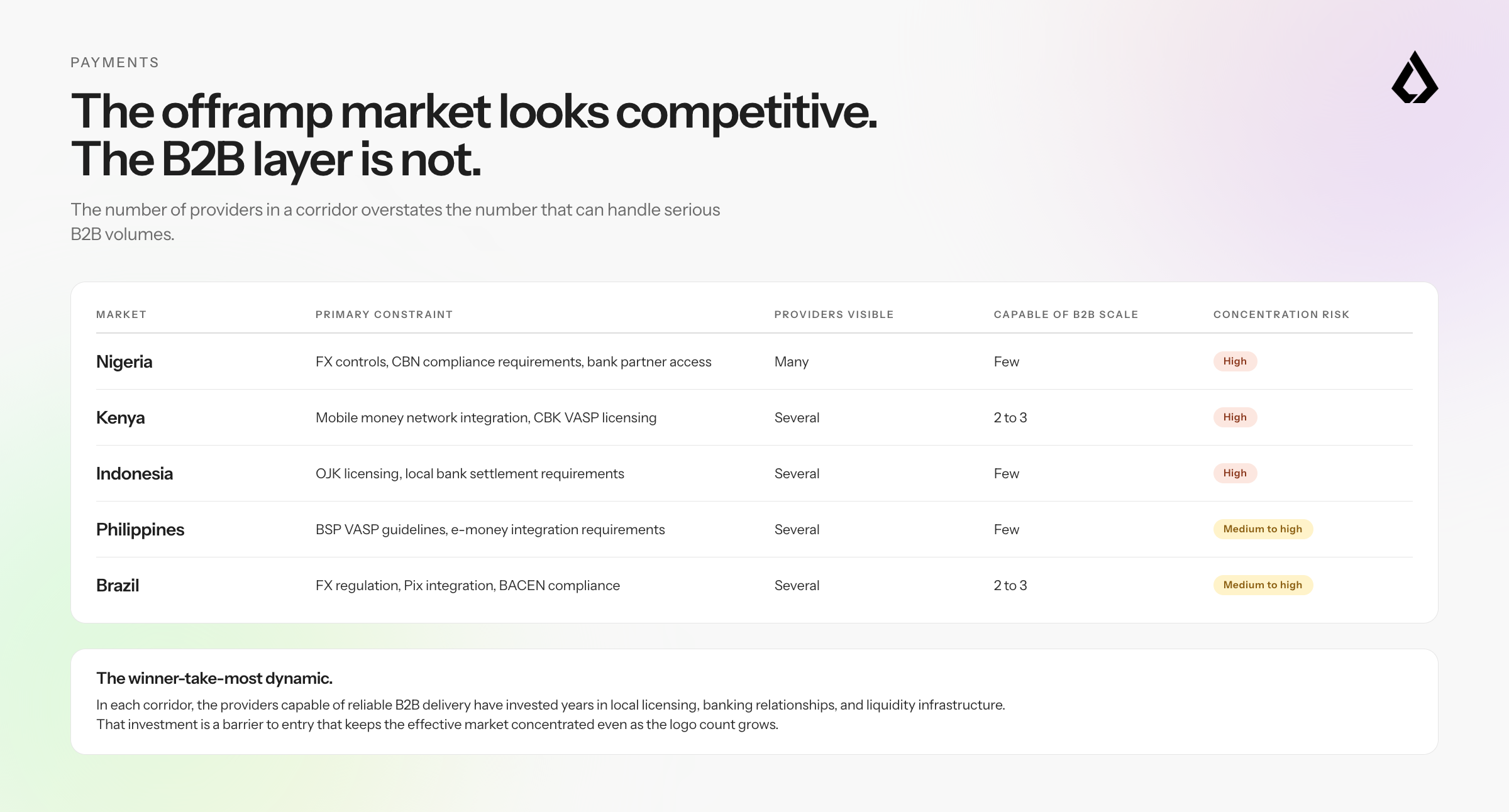
The assumption that offramps are interchangeable rests on a misreading of what an offramp actually provides. The conversion of a stablecoin balance into local fiat is the visible step. What sits beneath it — local banking relationships, prefunded liquidity in specific corridors, compliance onboarding and transaction monitoring, and API behaviour calibrated to specific payout rails — is what takes time to build and cannot be transferred. When a business moves to a new offramp provider, it does not port its existing setup. It starts again.
Compliance re-onboarding alone typically runs to weeks or months. A new provider re-runs know-your-business verification, beneficial-owner checks, sanctions screening, and source-of-funds review from the beginning. The compliance history accumulated with the previous provider — the transaction patterns, the risk assessments, the escalation history — does not transfer, because each firm's risk model, banking relationships, and regulatory obligations are their own. Industry research on B2B stablecoin payment infrastructure describes this clearly: the provider you have already trained to trust your transaction profile is usually the one that can move the largest volumes today, regardless of what a competitor's headline pricing looks like.
The practical consequence is staged activation. A new offramp relationship almost always begins with reduced limits and elevated review, particularly for businesses in higher-risk corridors or with meaningful B2B volume. During that period, the business is effectively running at reduced capacity through a provider it has not yet pressure-tested while remaining dependent on the provider it is trying to move away from. The transition window is expensive and operationally exposed.
The longer you run on one offramp, the more your operational stack is optimised for that provider's specific liquidity, compliance, and payout behaviour. The interchangeable-vendor assumption becomes less true every month.
Liquidity Depth Varies and the Ceiling Is Invisible Until You Hit It
Offramp providers do not publish their liquidity limits by corridor. A provider may comfortably handle retail remittance volumes in a given market and struggle to support the same business at B2B scale, because the underlying local fiat inventory, bank partner capacity, and settlement slack are fundamentally different at higher volumes. The gap between what a provider can do and what your business eventually needs is not visible at onboarding. It becomes visible when your daily payout profile spikes and the provider responds with slower settlement, wider spreads, reduced approval rates, or manual intervention that was not part of the original arrangement.
This is not a failure of the provider's infrastructure in any dramatic sense. It is a structural feature of how local liquidity works. Research on stablecoin cross-border payments in emerging markets consistently highlights that the difference between a provider that can move $50,000 a day in a given corridor and one that can move $5 million reflects how much local fiat inventory, bank access, and settlement capacity they have actually built in that market, not just their technical connectivity. A business that selected its offramp provider at small volumes may find, as it grows, that the provider's ceiling has arrived well before the business intended to reach it.
When volume exceeds a provider's comfortable ceiling, the experience is not an error. It is a degradation; slower payouts, more exceptions, more manual touchpoints, more operational overhead absorbed by the business's own team. The provider is still technically functioning. The business is still technically settling. But the unit economics and operational cost of running through that provider have silently shifted.
The Market Is More Concentrated Than the Logo Count Suggests
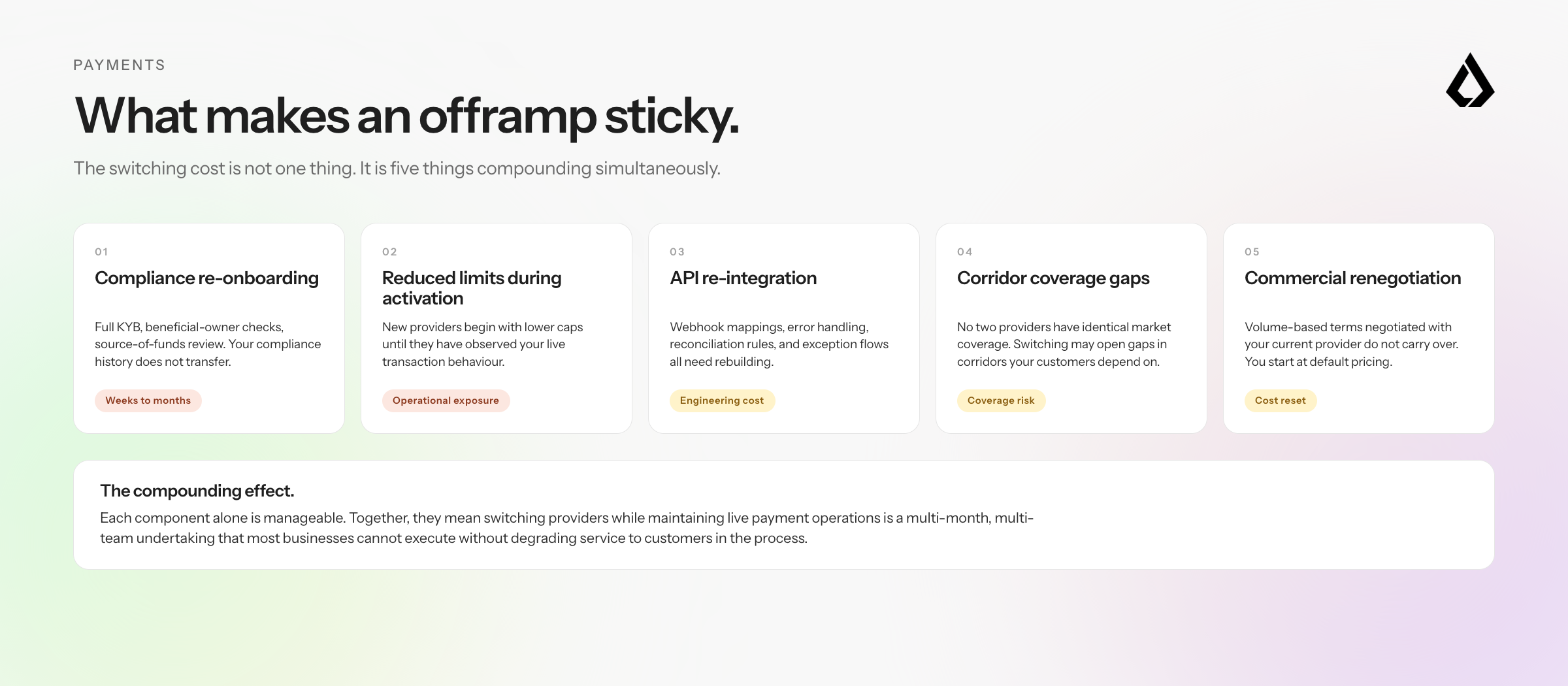
The offramp landscape appears competitive when measured by the number of providers operating. It looks different when measured by the number of providers that can reliably handle B2B volumes in a specific corridor. In most key emerging markets — Nigeria, Kenya, Indonesia, the Philippines, Brazil — the set of providers that combine local licensing, banking access, liquidity depth, and compliance infrastructure capable of supporting serious B2B flows is small. Cross-border payment analysis consistently identifies a winner-take-most dynamic at the operating level in these markets: a few scaled providers hold the majority of real B2B volume not because competitors do not exist, but because the infrastructure requirements for reliable B2B delivery at scale are high barriers to entry.
The practical implication is that concentration risk in the offramp market is higher than it appears from a list of provider names. The business that believes it has four viable offramp options in a given corridor may, on closer examination, have one or two that can actually handle its current volume, and possibly fewer as volume grows. The redundancy it believes it has is often notional rather than operational.
What Offramp Failure Actually Looks Like
Offramp failure is rarely a dramatic outage. It is a series of operational degradations that compound gradually and become visible only once the dependency is already deep. Common failure modes include payouts slowing from minutes to hours or days due to local liquidity imbalance, corridor pauses triggered by changes in bank partner policy or local compliance conditions, and limits being reduced or new manual approval requirements introduced with limited notice. B2B payment solution providers document these dynamics as routine operational events rather than exceptional incidents.
The downstream effect depends on how the business has integrated the offramp into its payment flow. For businesses using the offramp as part of a just-in-time payroll or working-capital process, a settlement delay of hours can cascade into a missed payroll run, a broken customer commitment, or a reconciliation exception that requires manual investigation across two systems. The stablecoin leg has settled. The value is provably there. It simply cannot be delivered to the recipient in the right local form at the right time. The rails have worked. The last mile has not.
Offramp failure is a settlement and service-level problem, not a blockchain problem. The distinction matters because the solution is not a better rail — it is better infrastructure around the rail.
How Sophisticated Operators Manage the Risk and What It Costs
The operators who have thought carefully about offramp concentration risk typically run multi-provider strategies: different corridors routed through different primary providers, secondary relationships maintained and kept warm, and active liquidity monitoring to catch ceiling events before they affect customers. Vendor selection frameworks for B2B stablecoin payments describe this approach as the standard for sophisticated operators, and note that most businesses do not implement it until they have already experienced a provider failure or hit a capacity cap.
The cost of running a genuine multi-provider strategy is not trivial. Each additional provider relationship requires a separate technical integration, a separate compliance onboarding process, separate commercial negotiation, and ongoing reconciliation across two sets of API responses and settlement records. Secondary providers also tend to operate with lower effective limits than the primary, because they have not observed the business's full production behaviour. The redundancy is real but partial, and it comes at a meaningful operational price.
What this reveals is a structural tension in how offramp infrastructure is built. A business that optimises for cost and simplicity tends to consolidate with one strong provider per corridor, and accumulates concentration risk it has not priced. A business that optimises for resilience spreads across providers, and pays a continuous operational tax to maintain relationships that are only needed when something goes wrong. Neither position is comfortable, and neither is the result of a bad decision. Both are the predictable outcome of treating the offramp as a commodity when it is not.