
It's Thursday, and you've got three tabs open before nine: the bank portal for the operating company, the multisig for the foundation, and the spreadsheet that explains one to the other. The spreadsheet's been open since Monday.
Contractors in Lisbon need paying today, so you start the stablecoin transfer and message the two signers. One of them's asleep. While you wait, you check on a supplier payment from the Swiss entity that went out yesterday and still says "pending". That isn't a word you can pass on to the supplier, because you don't know whether it's waiting on the bank, a compliance check or a colleague who hasn't looked at it yet.
Then there's Monday. The board wants the cash position across all four entities, which means pulling balances from every account the company holds, in four countries, some in dollars and some in stablecoins. You'll stitch it together by hand over the weekend, and by the time anyone reads it, it'll already be out of date.
If any of that sounds familiar, you don't need convincing that the system's broken.
The system was not built for you
The banking system that company runs on was designed for a business that lives in one country, holds one currency and files one set of accounts. Everything else is an exception. A company with entities in Cayman, Zug and Singapore, paying people in ten countries and holding stablecoins next to dollars, is an exception three times over, and it gets treated that way.
Accounts get opened and then closed, sometimes with a two-line email and no reason given. A transfer to a partner sits in review for a week, and the person on the phone can't tell you why because they can't see it either. Every new entity means another round of the same onboarding forms, the same certified documents, the same wait. Somewhere along the way the bank's calendar becomes the company's calendar. A payment approved on Friday evening lands on Tuesday, and a dollar wire costs $25 to $45 at the largest US banks before the exchange rate takes its own cut.
The industry's answer to all of this has been more tools. A bank for fiat. A multisig for stablecoins. A payments provider for the corridors the bank won't touch. Slack for approvals. A spreadsheet to reconcile the lot, maintained by a finance team that has slowly become the integration layer for the company's own money. When we interviewed finance leads at globally operating companies this year, nearly half named tool fragmentation and weak controls as their biggest pain, ahead of anything to do with the assets themselves. Teams told us they spend ten to twenty hours a month rebuilding the context around their own transactions. One company of about twenty-two people put it closer to fifteen hours a week.
Stablecoins solved one part of this, and it's a part that matters. Money now settles in minutes, on a Sunday, with no correspondent bank in the middle. B2B stablecoin payments reached $226 billion in 2025, more than eight times the year before, and the companies driving that growth are ordinary businesses with salaries and suppliers to pay. But settlement was never the whole problem. USDC in a multisig, approved in a group chat and matched to invoices in a spreadsheet, is just new money run the old way. The rails got faster. The way companies run their money didn't.
We lived it
We know this because we spent a decade inside it. Lisk built blockchain infrastructure while running our own finance function across several entities and jurisdictions, and we hit every wall described above: books closed across entities, approvers chased across time zones, context reconstructed after the fact, week after week. We got good at the workarounds. We also knew that being good at workarounds isn't a strategy, and that the problem underneath them was worth fixing properly.
Before we committed to it, we tested that view against other finance teams. We asked them to walk us through their weeks, and what came back was the same tools, the same spreadsheet, the same Thursday. That confirmed it. We made the decision to shut down our own chain and build the finance platform that we, and the companies we'd been talking to, actually needed.
That's what Lisk is today: the modern finance platform for businesses.
What modern finance means
Modern finance is a finance function that runs on the company's terms. It means a payment goes out the moment it's approved, with no second step where someone has to go back into a portal and actually send it. It means the money takes the fastest rail available, with nothing lost to a chain of intermediaries along the way.
It means every movement carries its own explanation, with the name, the approval and the reason attached as it happens, so there's nothing to piece together at month-end. It means the rules live inside the system that holds the money, so a thumbs-up in a chat thread is never mistaken for a control. And it means one ledger for everything the company holds, whatever form it's in.
That's a standard, not a feature list, and most of what companies run on today doesn't come close to it.
Running money to that standard is what we call modern money operations.
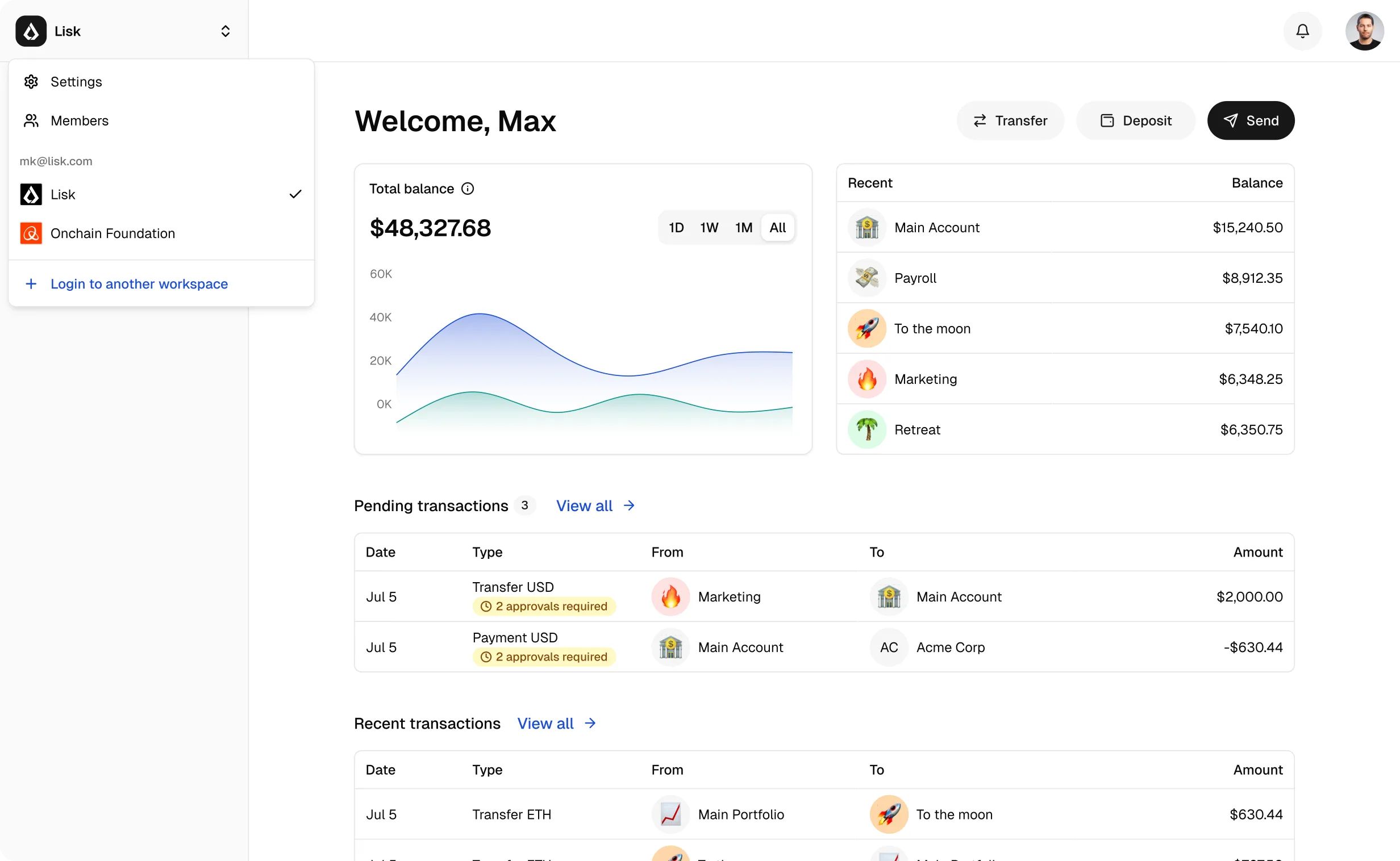
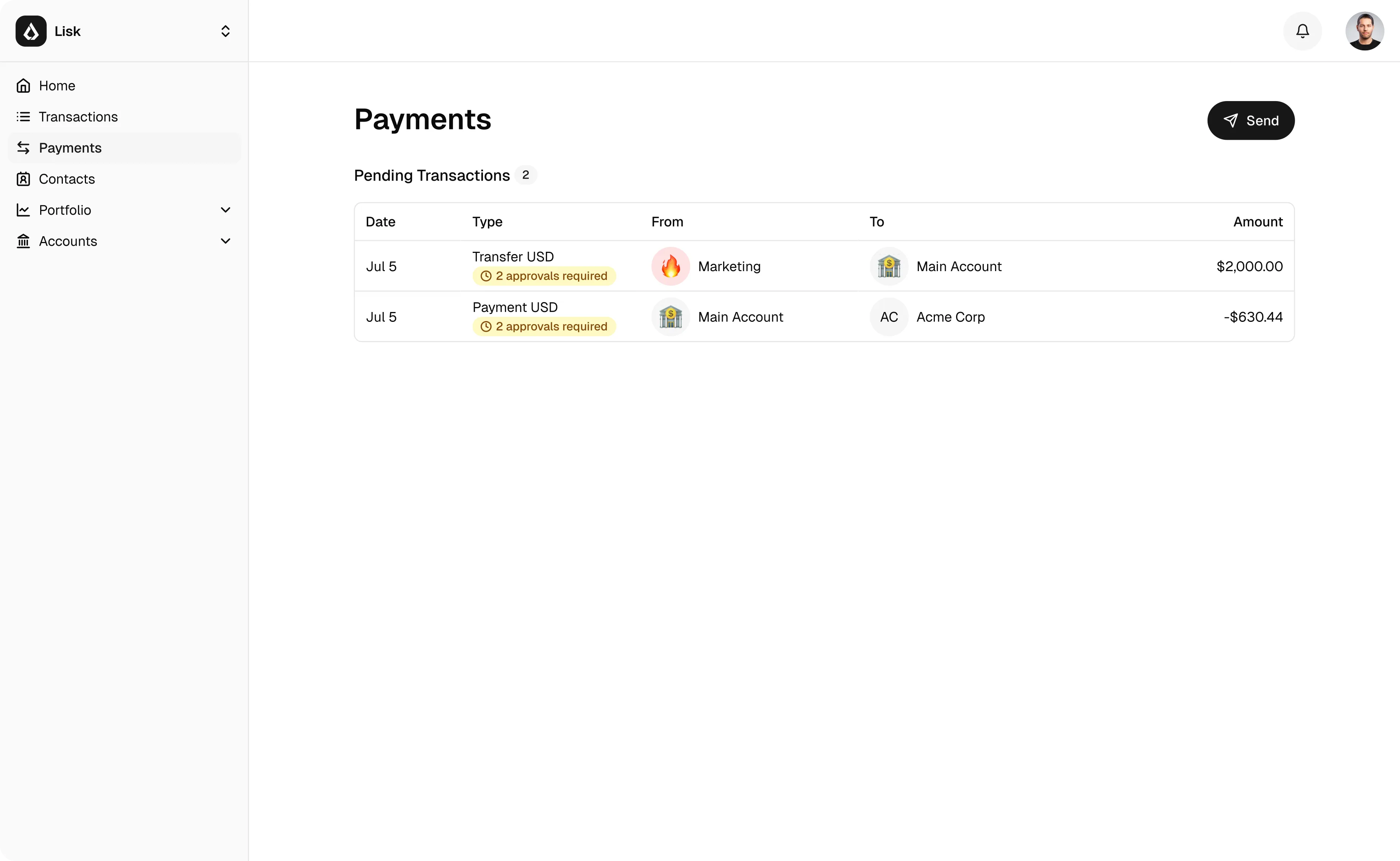
Now run the same Thursday against it. You open one screen and see every entity's balance, fiat and stablecoin together. The Lisbon payments go out as stablecoin the moment the second approver signs off, and the system asks him directly and records it when he does, so nobody's chasing anyone. The Swiss supplier payment tells you exactly where it is, whether that's awaiting approval, sent or settled, along with who initiated it and who approved it. So the supplier gets a real answer. And Monday's cash position? It's the dashboard you've had open all week.
None of this removes the obligations that come with moving money. Onboarding, KYB, sanctions screening and reporting all still apply, exactly as they should. What disappears is the work around them, the hours nobody should have to spend just to know where the money is.
What we're doing about it
That's the standard we built the new Lisk to meet. One place to hold your money in whatever form it takes, one policy that decides who can move it, and a record that's created as it happens, whichever rail it went out on.
The problem was never that global finance is hard. Plenty of things in finance are hard, and teams handle them every day. The problem is that the systems underneath were built for a different kind of company, and everyone running a global one has been quietly holding those systems together by hand for so long that it started to feel like part of the job. It was never meant to be.
The spreadsheet that's been open since Monday, the signer who's asleep, the word "pending" with nothing behind it. That's the old way, and it's what we're here to replace. Finance teams have better things to do with their weeks, and we're here to give those weeks back.