Most businesses treat payments as something that gets wired in after the product is built. A Stripe integration here, a payout API there, a bank account to collect from customers. The payment is a feature — useful, necessary, but not the point. For a growing class of crypto-native businesses, that framing is exactly backwards. The payment is not a feature attached to something else. It is the thing itself.
B2B stablecoin payment platforms, onramp and offramp providers, payroll infrastructure companies, cross-border rails, treasury-as-a-service businesses — for all of these, the payment flow is the primary workflow. The business differentiates on coverage, reliability, unit economics, and compliance posture, not on a user interface sitting on top of someone else’s infrastructure. As Fintech Takes describes the shift, payments have moved from product feature to infrastructure, and for the businesses at the centre of that shift, the infrastructure decisions made in the first twelve to eighteen months determine what the product can become.
Infrastructure Decisions Are Product Decisions
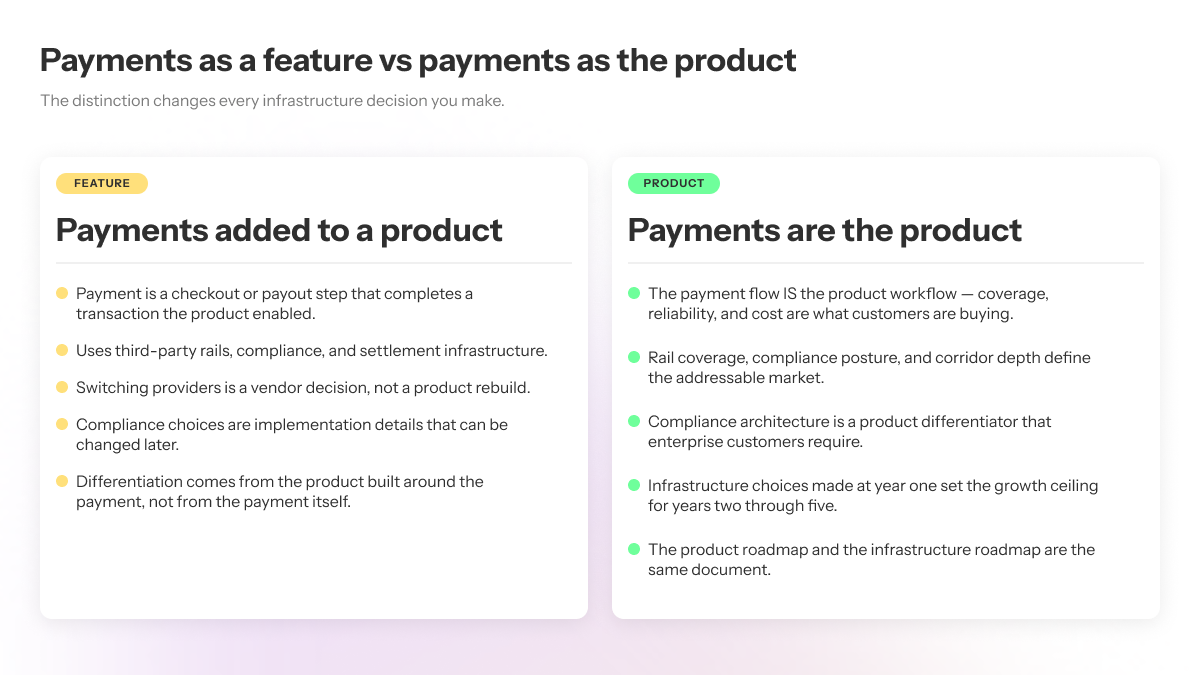
The distinction between a business that uses payments and a business whose product is payments matters because it changes which decisions are strategic and which are operational. For most businesses, choosing a payment processor is an operational decision — you pick the one that integrates cleanly with your stack and move on. For a business where payments are the product, that same decision is a product roadmap decision. It determines which corridors you can serve, which customers you can onboard, which use cases you can support, and at what cost.
Settlement rails. Which chains, which stablecoins, and which fiat corridors you support is not a technical configuration choice. It is your product’s coverage. Bitso’s unified payments architecture, a single API covering local collection and payouts across Latin American markets via Pix, SPEI, ACH, and onchain rails, is not a feature on top of a product. It is the product. The decision to integrate each of those local rails, and to build the FX and reconciliation layer that sits behind them, made every subsequent product decision possible or constrained it.
Compliance architecture. The depth of know-your-business verification, the Travel Rule implementation, the sanctions screening methodology, and the data retention approach all determine which customers you can serve and which use cases are open to you. Bitso positions its B2B stablecoin payments explicitly as compliance-first, with Travel Rule and sanctions screening embedded in the payment flow. That is not a compliance team decision. It is a product positioning decision that opens the door to enterprise customers and regulated counterparties who will not touch flows without end-to-end traceability.
Treasury and liquidity design. How liquidity is managed across chains, currencies, and local bank accounts determines whether you can offer instant payouts, real-time foreign exchange, or local-currency settlement. The pre-funding decisions — how much float to hold, where, and in what form — directly affect working capital requirements and unit economics. Fireblocks’ stablecoin payments network, which has settled over $10 trillion and onboarded providers including Yellow Card and OpenPayd, is built on programmable settlement and multi-asset treasury orchestration. The treasury architecture is what makes the product’s speed and coverage promises possible to keep.
Reconciliation and the data layer. How transactions are modelled, tracked, and reported across chains and bank rails determines how quickly volumes can scale and how easily new corridors can be added. Poor reconciliation design does not stay contained in the finance team. It surfaces as settlement breaks, slow month-end closes, and an inability to give customers the real-time reporting they expect from a payments product. BVNK’s analysis of blockchain in cross-border payments identifies reconciliation and settlement finality as core infrastructure questions — not accounting questions — for businesses building on these rails.
The Cost of Getting It Wrong Early
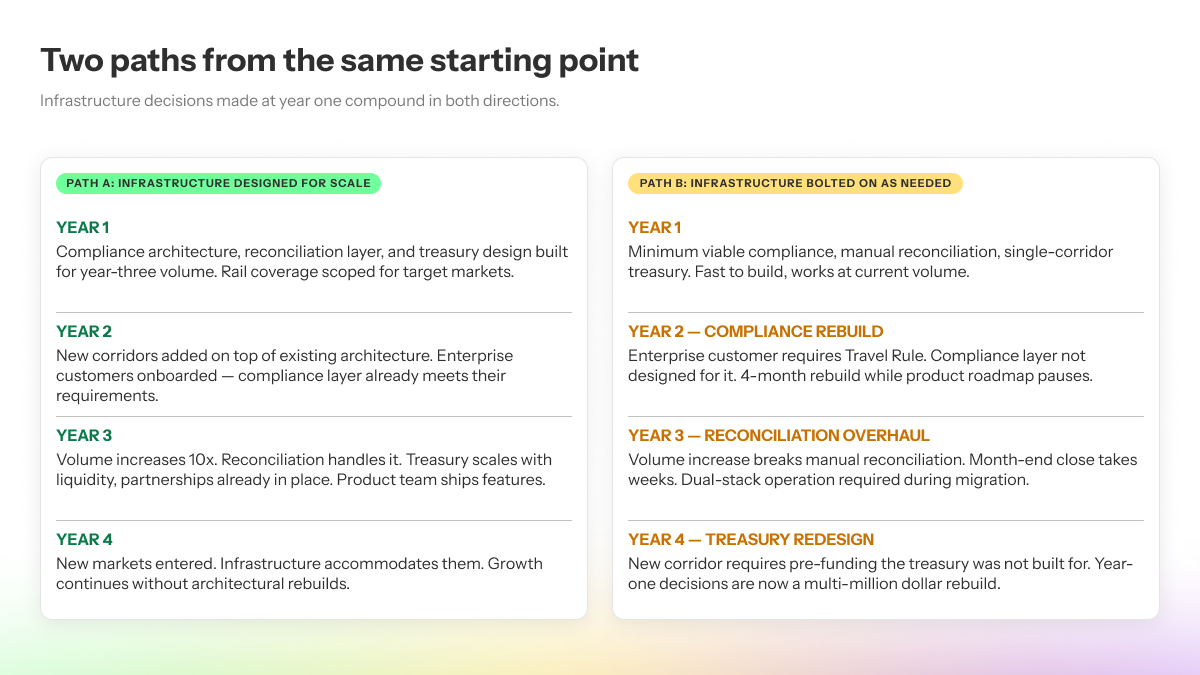
The compounding problem with infrastructure decisions made casually is that they are expensive to undo. Payments infrastructure that was built to handle a specific volume, on a specific set of rails, with a specific compliance approach does not gracefully accommodate a business that has grown beyond those assumptions. It has to be rebuilt, and rebuilding payment infrastructure mid-growth is not a sprint. Industry benchmarks for payment processor modernisation put phased modernisation programs at $500,000 to $5 million over three to five years, with full platform rebuilds running $2 million to $10 million or more depending on complexity. Those figures cover engineering and vendor cost. They do not capture the cost of running dual stacks during migration, the risk window when failures can affect customer funds, or the product velocity lost while the engineering team is rebuilding infrastructure instead of shipping features.
The specific failure modes that emerge when payments infrastructure cannot keep up with product growth are predictable. Scaling analyses of crypto payment platforms identify the most common: an inability to add new corridors because the data model was built for a single-currency assumption, compliance backlogs that emerge as volume grows because screening was designed for manual review at lower throughput, and month-end reconciliation crunches that prevent serving enterprise customers who need auditable real-time reporting. Each of these is a growth ceiling, not a temporary operational problem. And each traces back to a design decision made early, when the infrastructure seemed adequate for the business at the time.
The businesses that avoid this are not the ones with the largest engineering teams. They are the ones that made the connection between infrastructure choices and product constraints early enough to design for where they were going rather than where they were.
What the Leading Businesses Actually Built
Looking at the businesses that have built the most durable payments infrastructure in emerging markets, a pattern emerges: they built the hard parts themselves and bought or partnered on everything else.
Yellow Card built its own local onramp and offramp stack and regulatory infrastructure across Africa — the parts that are genuinely difficult to buy and that create real defensibility — and then integrated with partners including PayPal, Coinbase, and Block for volume and distribution. Blockchain Capital’s analysis of Yellow Card’s approach frames the licensing footprint and compliance posture as the core product asset, not just the rails. The compliance infrastructure is what makes the stablecoin a practical B2B payment method rather than a speculative asset in those markets.
Chipper Cash started with mobile money and bank integrations and has built out from there. In December 2025 it partnered with Stable to implement stablecoin rails across its cross-border payment network in Africa, a strategic rail choice that reflects a deliberate decision about which settlement infrastructure to build the next phase of the product on. That is not a vendor integration. It is a product architecture decision.
MoneyGram’s December 2025 partnership with Fireblocks to implement a programmable settlement layer for global treasury and real-time payments reflects the same logic at institutional scale: the settlement architecture is not a back-office function. It is the product capability that determines what the business can offer its customers and partners.
The Embedded Payments Extension
There is a related pattern worth understanding for non-payments businesses that are considering whether to own payment infrastructure rather than outsource it. The decision is increasingly common and the product and commercial implications are significant.
When invoices, payments, and payouts all happen inside the product, payments shift from a background service to a core workflow. Stripe’s guidance on platform payments documents how the businesses that have done this most effectively — Shopify, Toast, Gusto — treat the payment capability as a revenue line and a data asset, not a cost of doing business. The design decisions about onboarding, settlement timing, payout mechanics, and reporting become core product features for their customers.
For crypto-native businesses, the same logic applies with an additional layer of complexity. Embedding stablecoin payment flows into a non-payments product shifts Travel Rule obligations, sanctions screening requirements, and onchain analytics onto the platform. The compliance implications of owning the payment flow are not optional extras, they are part of the product decision. Businesses that understand this upfront can design for it. Businesses that discover it mid-implementation typically face a significant rebuild.
What This Means for How You Build
The practical implication for any business where payments are central to the value proposition is that the infrastructure conversation needs to happen at the same time as the product conversation, not after it. The questions that determine what you can build — which corridors, which customer segments, which compliance posture, which treasury architecture — are not implementation details. They are strategy.
The businesses that have built the most durable payments products in emerging markets did not wait until they had scale to make these decisions. They made them early, accepted that building the right infrastructure was more expensive upfront than integrating a third-party processor, and let that infrastructure become the thing that competitors could not easily replicate. The coverage, the compliance posture, the reconciliation layer, these things take time to build correctly. They also take time to copy. As BVNK’s analysis of cross-border payments infrastructure notes, the businesses that treat infrastructure as a product surface rather than a back-office cost are the ones that end up with defensible market positions, not just market share.